
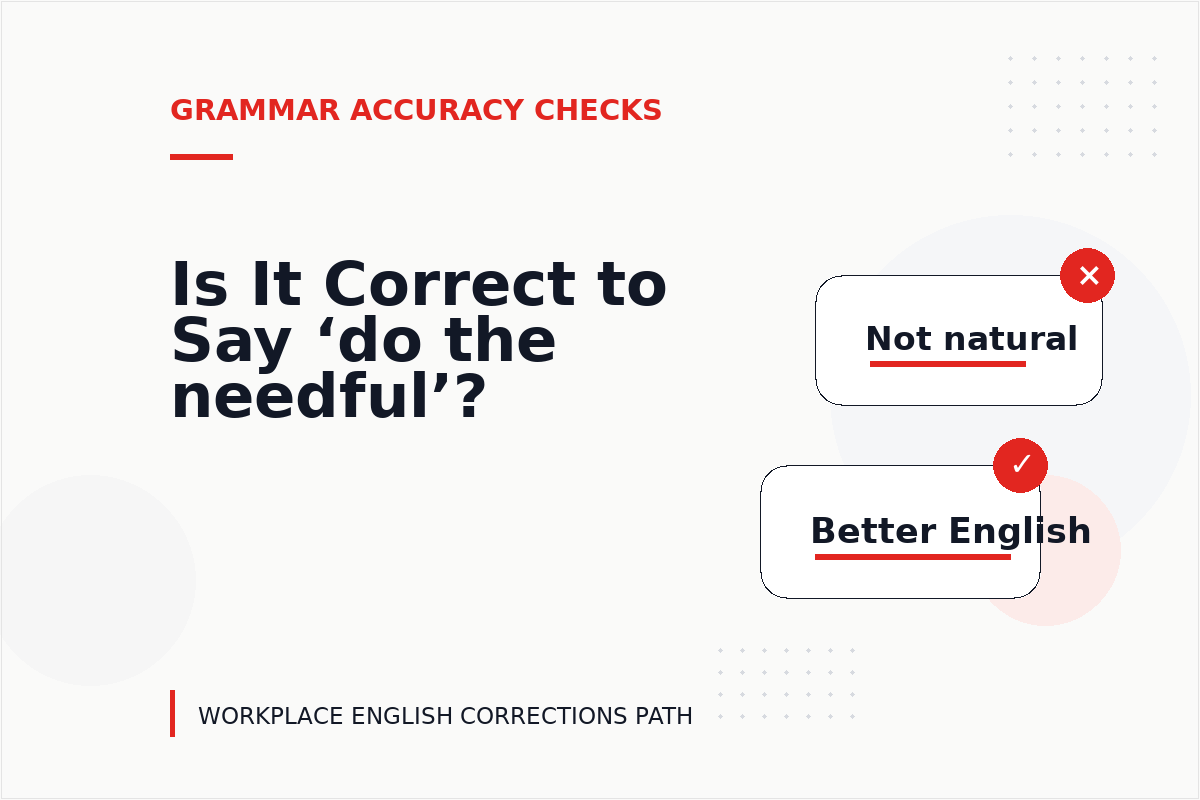
Yes, the phrase “do the needful” is grammatically correct, but it is not commonly used in modern standard English, especially in American or British workplaces. It is a formal, somewhat old-fashioned expression that means “do what is necessary” or “take the required action.” While you may still hear it in Indian English and some other South Asian varieties, using it in international business emails or conversations can sound awkward or unclear to many native speakers. For most workplace communication, a clearer and more direct alternative is recommended.
Quick Answer
“Do the needful” is correct but outdated and region-specific. It is best avoided in global workplace English. Instead, use phrases like “please take the necessary steps,” “kindly do what is required,” or “please handle this.” These alternatives are clearer and more widely understood.
What Does “Do the Needful” Mean?
The phrase “do the needful” is a fixed expression that instructs someone to complete a task or take action that is expected or required. It is often used in formal or bureaucratic contexts, particularly in written instructions. The word “needful” here acts as a noun meaning “what is needed.”
For example:
- “Please do the needful and submit the report by Friday.”
- “Kindly do the needful regarding the invoice.”
While the meaning is clear in some regions, many English speakers find it vague because it does not specify what action is required. This can lead to confusion or requests for clarification.
Formal vs. Informal Tone
“Do the needful” is generally considered formal, but it is not universally accepted as professional. In formal writing, such as official letters or legal documents, it may appear, but even there, more precise language is preferred. In informal conversation or casual emails, it sounds stiff and unnatural.
| Tone | Example | Appropriateness |
|---|---|---|
| Formal (traditional) | “Please do the needful at your earliest convenience.” | Acceptable in some regions, but vague |
| Formal (modern) | “Please complete the required steps.” | Clear and professional |
| Informal | “Can you handle this?” | Natural and direct |
Context: Email vs. Conversation
In emails, “do the needful” is sometimes used in Indian English and other Asian varieties. However, in international business, it can mark you as a non-native speaker or cause misunderstanding. In spoken conversation, it sounds even more out of place. Most native speakers would say something like “please take care of it” or “please do what’s needed.”
Natural Examples
Here are examples showing how “do the needful” might appear and how it can be improved:
- Original: “Kindly do the needful and send the documents.”
Improved: “Please send the documents.” - Original: “We have received your request. Please do the needful.”
Improved: “We have received your request. We will process it shortly.” - Original: “Do the needful for the payment.”
Improved: “Please process the payment.”
Common Mistakes
Learners often misuse “do the needful” in ways that sound unnatural. Here are common errors:
- Mistake: “Please do the needful work.”
Correction: “Please do the needful.” (The word “needful” already implies the work.) - Mistake: “I will do the needful for you.”
Correction: “I will take care of it.” (More natural in most contexts.) - Mistake: “Do the needful as soon as possible.”
Correction: “Please complete this as soon as possible.” (More specific.)
Better Alternatives
Instead of “do the needful,” choose one of these clearer alternatives depending on the situation:
- Please take the necessary action. – Formal and clear.
- Kindly handle this. – Polite and direct.
- Please do what is required. – Simple and understandable.
- Please complete the task. – Specific and professional.
- Please follow up on this. – Good for reminders.
When to Use It
You might still use “do the needful” if you are writing for an audience that is familiar with the phrase, such as in certain Indian business contexts or when corresponding with colleagues who use it regularly. However, even then, it is safer to use a more universal expression to avoid ambiguity. In all other workplace English, especially in international settings, avoid it.
Mini Practice Section
Test your understanding with these questions. Choose the best alternative for each sentence.
1. “Please do the needful for the contract.”
A) Please sign the contract.
B) Please do the needful work.
C) Please handle the needful.
Answer: A) Please sign the contract.
2. “Kindly do the needful and confirm your attendance.”
A) Kindly do the needful and confirm.
B) Please confirm your attendance.
C) Do the needful for confirmation.
Answer: B) Please confirm your attendance.
3. “We have updated the file. Do the needful.”
A) We have updated the file. Please review it.
B) We have updated the file. Do the needful.
C) We have updated the file. Do the needful work.
Answer: A) We have updated the file. Please review it.
4. “I will do the needful regarding your request.”
A) I will do the needful.
B) I will process your request.
C) I will do the needful work.
Answer: B) I will process your request.
Frequently Asked Questions
Is “do the needful” grammatically correct?
Yes, it is grammatically correct. “Needful” is used as a noun meaning “what is needed.” However, it is considered old-fashioned and is not common in modern standard English.
Can I use “do the needful” in professional emails?
It depends on your audience. In some regions, especially India, it is still used in professional emails. In most international workplaces, it is better to use clearer alternatives like “please take the necessary steps.”
What is a good replacement for “do the needful”?
Good replacements include “please handle this,” “please take the required action,” “please complete the task,” or “please do what is necessary.” Choose the one that fits your specific situation.
Why do some people say “do the needful”?
This phrase is a remnant of older British English and has remained in use in some former British colonies, particularly in South Asia. It is a fixed expression that has persisted in certain business and bureaucratic contexts.
For more help with workplace English, explore our Grammar Accuracy Checks or visit our FAQ page. If you have questions, feel free to contact us. You can also review our Editorial Policy for more information about our approach.


Comments are closed.