1

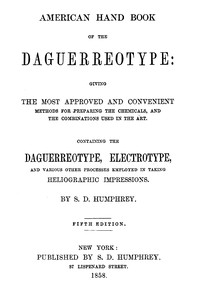
American Hand Book of the Daguerreotype — Story, Setting & Ideas
(0 User reviews)
113
Project Gutenberg
1994
Not confirmed
Photography; Daguerreotype
Readers of public-domain and historical texts
Project Gutenberg digital edition
en
Edition facts
Words
46,540
Reading time
203 min
Text sections
4
The catalog record for American Hand Book of the Daguerreotype — Story, Setting & Ideas provides practical reading context through 46,540 words, 3 hr 23 min estimated reading time, and 4 detected text sections.
The text analysis averages about 23.7 words per sentence, while the detected sections provide another way to judge how the source is divided.
Project Gutenberg metadata also associates the work with “Photography,” connecting these edition facts with the source record’s subject description.
Source:
Project Gutenberg record #167
S. D. Humphrey's 1858 manual details daguerreotype chemistry and technique, emphasizing practical methods for preparing compounds like bromide of lime and Gurney's American Compound, with precise coating and exposure instructions.
Read the complete public-domain text at its original source.
Read on Project GutenbergHumphrey opens his fifth edition with a dedication to J. Gurney, praising his "professional skill, scientific accuracy, and energetic perseverance." The preface immediately establishes the book's purpose: to supply "concise and reliable information" for amateur and professional daguerreotypists. The author notes that daguerreotypes are then believed "more durable than any other style of 'Sun-drawing,'" justifying the timing of this edition. The table of contents reveals a systematic structure: Chapter I covers the entire process from polishing to coloring, while Chapter II lists specific recipes and solutions. This organization suggests the book is meant for hands-on reference, not theoretical reading.
The Chemistry of Accelerators
The excerpts focus heavily on preparing "accelerators"—compounds that speed up the plate's sensitivity. Humphrey details making hydrate of lime by slaking quicklime in warm water, warning against overheating lest it revert to carbonate. He specifies using "oyster-shell lime" for purity, as impurities prevent bromine combination. For bromide of lime, he instructs filling a four-quart bottle two-thirds full of hydrate, adding bromine in increments, shaking well, and letting it stand for hours. The compound "improves by age." The desired color is a "fine red." These instructions reveal a trial-and-error craft: the practitioner must judge colors and textures, not just follow fixed ratios.
Gurney's Two-Temperature System
Humphrey presents Gurney's American Compound in two formulations: No. 1 for temperatures above 65–70°F, No. 2 for lower. No. 1 adds pulverized burnt alum, a trace of chloride of lime, and dry iodine to the hydrate of lime—just enough iodine to prevent "flaring" or "scum-coating." The iodine must be "thoroughly combined" over one or two days before adding bromine to a "light red color." No. 2 omits iodine. The coating sequences differ: for No. 1, coat iodine to "bright yellow," then compound to red, then recoat iodine for one-sixth the first time; for No. 2, recoat for one-fourth to one-half. These precise variations show how environmental conditions dictated recipe adjustments.
Dry Quick and Starch Additives
Another compound, Dry Quick, No. 1, mixes equal quarts of hydrate of lime and finely pulverized starch, then adds bromine until "deep yellow or pink." Humphrey notes the claim that starch holds bromine longer, but he doubts it: "Our experience in practice has led us to the conclusion that there is no great difference as respects durability." However, he concedes a difference in "the tone of the impressions." He adds that starch may be added to any dry mixture. The coating instruction is similar: iodine to deep yellow, then quick to red, recoat one-sixth. This section exemplifies the book's empirical tone—Humphrey tests claims against his own practice and reports honestly.
Reading the Recipes as a Practitioner
These excerpts are not a narrative but a set of operational protocols. The reader must interpret phrases like "coat over the iodine to a rose red" as visual benchmarks, not numerical targets. The repeated warnings—against overheating lime, against impurities, against insufficient iodine—indicate common failure points. The book assumes the reader has equipment (camera, buffs, mercury bath) and chemicals (iodine, bromine, hyposulphite). The dedication to Gurney and the mention of "Gurney's American Compound" suggest a community of practitioners sharing refinements. A first-time reader should approach the text as a lab manual: read each recipe fully before mixing, and note the color descriptions as critical quality checks.
Humphrey's handbook rewards careful, sequential reading. The recipes build on each other: understanding hydrate of lime is prerequisite to bromide of lime, which is prerequisite to Gurney's compounds. The book's value lies in its specificity—exact bottle sizes, color targets, and warnings against common errors. Readers interested in historical photographic practice will find a detailed record of mid-19th-century chemical craft, while modern practitioners may adapt the methods with appropriate safety precautions.
Flipping through Humphrey's precise daguerreotype formulas, I felt the patient craft of fixing light onto silver. It reminded me, oddly, of walking among the frozen marble figures at the Exposition, each one a captured moment of intended grace. Both feel like hushed attempts to hold something fleeting—chemical or sculpted—and keep it quietly permanent. That same gentle, deliberate spirit lingers in Sculpture of the Exposition Palaces and Courts Descriptive Notes on the Art of the Statuary at the Panama-Pacific International Exposition, San Francisco — A Closer Reading, where description feels like a soft touch.
There are no reviews for this eBook.
There are no comments for this eBook.
Reader reflection
Your personal reading reflection
Build a private reading journal entry for this title.
Your progress
0
/
10
2
How did the book work for you overall?
3
Would you encourage someone else to read it?
4
How demanding did the text feel?
5
Did anything about the book feel genuinely new?
6
How would you describe its reading pace?
7
Did any part of the book feel personally relevant?
8
Which part made the strongest impression?
9
What did this book teach you most?
10







![Cover of Stones of Venice [introductions] — A Reader’s Guide](https://buaev.com/storage/media/covers/pg9804.jpg)