
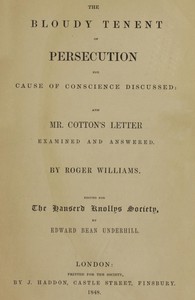
The Bloudy Tenent of Persecution for Cause of Conscience Discussed and Mr.…
This isn't a novel with a plot. Instead, imagine two characters having a long, intense conversation. Their names are Truth and Peace. Through their dialogue, Roger Williams makes his case. He argues that governments have no right to punish people for what they believe. Using the Bible itself, he dismantles the common idea that the state should enforce religious uniformity. He saw the violence and hypocrisy that came from forced belief, and he pleaded for a 'wall of separation' between the garden of the church and the wilderness of the world.
Why You Should Read It
Reading Williams is like getting a front-row seat to the birth of a radical American idea. His passion leaps off the page. You can feel his frustration with the system and his deep conviction that conscience is sacred. It's humbling to see how clearly he saw the problems of mixing political power with religious authority. While the 17th-century language takes some getting used to, the core argument is powerful and direct.
Final Verdict
This is for the curious reader who wants to understand where some of America's foundational ideas came from. It's perfect for history buffs, anyone interested in religious freedom debates, or people who like primary sources. Don't expect a light narrative. Do expect to be challenged by a brilliant, stubborn mind from 400 years ago who still has something urgent to say.
No rights are reserved for this publication. You can copy, modify, and distribute it freely.
Anthony Lopez
1 year agoFrom the very first page, the atmosphere created is totally immersive. I couldn't put it down.
James Harris
1 year agoThe formatting on this digital edition is flawless.
Linda Smith
1 year agoEssential reading for students of this field.
Christopher Torres
1 year agoHigh quality edition, very readable.






Joseph Torres
1 year agoGreat read!