
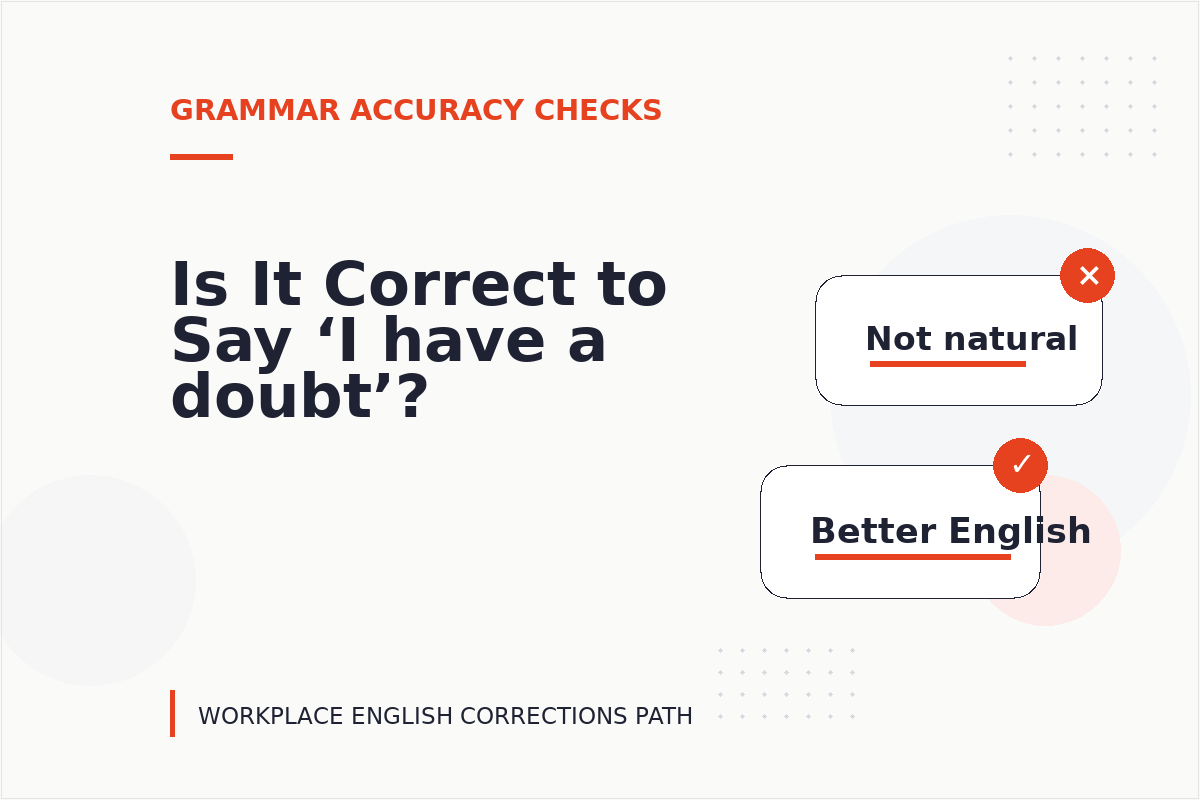
No, the phrase “I have a doubt” is not considered correct or natural in standard English, especially in professional or workplace contexts. While it is a direct translation from several languages (such as Spanish, Portuguese, French, and Italian), native English speakers do not use “doubt” in this way. Instead, they would say “I have a question,” “I have a concern,” or “I am not sure about something.” Using “I have a doubt” can confuse your listener or reader, as it suggests you are skeptical or disbelieve something, rather than simply seeking clarification. This guide will explain the difference, provide natural alternatives, and help you avoid this common mistake in your workplace English.
Quick Answer: What Should You Say Instead?
If you want to ask for clarification or express uncertainty, use one of these phrases instead of “I have a doubt”:
- I have a question. (Use this when you need information or an explanation.)
- I have a concern. (Use this when you are worried about something.)
- I am not sure about [something]. (Use this to express uncertainty.)
- Could you clarify [something]? (Use this in formal emails or meetings.)
- I am unclear about [something]. (Use this to say you do not fully understand.)
In short, avoid “doubt” when you mean “question.” Save “doubt” for situations where you genuinely disbelieve something.
Understanding the Core Mistake
The error comes from a direct translation. In many languages, the word for “doubt” is also used to mean “question” or “uncertainty.” However, in English, the word doubt has a stronger, more specific meaning. It implies a lack of trust or a belief that something is not true or not likely. For example:
- “I doubt he will finish the report on time.” (I believe he will not finish it.)
- “She has doubts about the new policy.” (She is skeptical or does not trust it.)
When you simply need to ask for more information, using “doubt” sounds unnatural and can even sound negative. Your colleague might think you are questioning their honesty or ability, rather than just asking a simple question.
Formal vs. Informal Contexts
The mistake is common in both formal and informal settings, but it is especially noticeable in professional emails and meetings. In casual conversation, a native speaker might understand what you mean, but it will still sound foreign. In writing, it is a clear red flag that marks the sentence as non-native. Here is how the tone changes:
- Informal conversation: “I have a doubt about the meeting time.” (Awkward, but understood.)
- Formal email: “I have a doubt regarding the budget.” (Unprofessional; use “question” or “concern.”)
- Academic writing: “The researcher had a doubt about the methodology.” (Incorrect; use “question” or “reservation.”)
Comparison Table: “Doubt” vs. “Question” vs. “Concern”
| Word/Phrase | Meaning | When to Use | Example |
|---|---|---|---|
| Doubt | A feeling of uncertainty or lack of conviction; disbelief. | When you do not believe something is true or will happen. | “I doubt the data is accurate.” |
| Question | A sentence seeking information or clarification. | When you need an answer or explanation. | “I have a question about the deadline.” |
| Concern | A worry or issue that needs attention. | When you are worried about a problem or risk. | “I have a concern about the project timeline.” |
| Uncertainty | The state of being unsure. | When you are not sure about a fact or decision. | “There is some uncertainty about the budget.” |
Natural Examples in Workplace Contexts
Here are real-world examples of how to correctly express uncertainty or ask for clarification in different workplace situations.
In Emails
- Incorrect: “I have a doubt about the attachment you sent.”
Correct: “I have a question about the attachment you sent. Could you confirm it is the latest version?” - Incorrect: “I have a doubt regarding the meeting agenda.”
Correct: “I am unclear about item 3 on the agenda. Could you please clarify?” - Incorrect: “Please let me know if you have any doubts.”
Correct: “Please let me know if you have any questions.”
In Meetings
- Incorrect: “I have a doubt about the sales forecast.”
Correct: “I have a question about the sales forecast. How did you arrive at these numbers?” - Incorrect: “I doubt the new software will work.” (If you mean you are unsure, not skeptical)
Correct: “I am not sure if the new software will work. Can we test it first?”
In Casual Conversation with Colleagues
- Incorrect: “I have a doubt about the lunch order.”
Correct: “I am not sure about the lunch order. Did we decide on pizza?” - Incorrect: “Do you have any doubts?”
Correct: “Do you have any questions?”
Common Mistakes and How to Fix Them
Here are the most frequent errors learners make with “doubt,” along with the correct alternatives.
Mistake 1: Using “doubt” to mean “question”
Wrong: “I have a doubt about the instructions.”
Right: “I have a question about the instructions.”
Mistake 2: Using “doubt” in a polite request
Wrong: “I doubt you could help me with this.” (This sounds like you do not believe the person can help.)
Right: “Could you help me with this?” or “I was wondering if you could help me with this.”
Mistake 3: Using “any doubt” in a closing line
Wrong: “Please contact me if you have any doubt.”
Right: “Please contact me if you have any questions.”
Mistake 4: Using “doubt” when you mean “uncertainty”
Wrong: “There is a doubt about the schedule.”
Right: “There is some uncertainty about the schedule.” or “The schedule is not confirmed.”
Better Alternatives: When to Use Each One
Choosing the right word depends on what you really mean. Here is a quick guide.
Use “I have a question” when:
- You need information.
- You want an explanation.
- You are asking for clarification.
- Example: “I have a question about the report format.”
Use “I have a concern” when:
- You are worried about a potential problem.
- You want to raise an issue.
- Example: “I have a concern about the project deadline. It seems very tight.”
Use “I am not sure” or “I am unclear” when:
- You are uncertain about a fact or detail.
- You do not fully understand something.
- Example: “I am not sure if the meeting is at 2 PM or 3 PM.”
Use “I doubt” only when:
- You believe something is unlikely or not true.
- You are skeptical.
- Example: “I doubt the proposal will be approved without more data.”
Mini Practice: Test Yourself
Choose the correct phrase to complete each sentence. Answers are below.
- I have a _______ about the new policy. Can you explain it?
a) doubt
b) question
c) both are correct - I _______ the numbers are correct. They seem too high.
a) have a question
b) doubt
c) am unclear - Please let me know if you have any _______.
a) doubts
b) questions
c) both are correct - She expressed a _______ about the safety of the equipment.
a) question
b) doubt
c) concern
Answers: 1. b) question, 2. b) doubt, 3. b) questions, 4. c) concern
Frequently Asked Questions
1. Is “I have a doubt” ever correct in English?
Yes, but only in very specific contexts. For example, if you are expressing genuine disbelief: “I have a doubt that he will arrive on time.” However, this is much less common than simply saying “I doubt he will arrive on time.” In everyday workplace English, it is almost always better to use “question” or “concern.”
2. Why do so many non-native speakers say “I have a doubt”?
This is a direct translation from many languages, including Spanish (“tengo una duda”), French (“j’ai un doute”), Portuguese (“tenho uma dúvida”), and Italian (“ho un dubbio”). In those languages, the word for “doubt” is also used to mean “question” or “uncertainty.” Learners naturally transfer this pattern to English.
3. What should I say instead of “Do you have any doubts?” at the end of a presentation?
Use “Do you have any questions?” or “Are there any questions?” If you want to invite concerns, you can say “Do you have any questions or concerns?” This is the standard and professional way to close a presentation or meeting.
4. Can I use “doubt” in a formal email?
It is best to avoid it unless you mean genuine disbelief. For example, in a legal or audit context, you might write: “We have doubts about the accuracy of the financial statements.” But for routine clarification, always use “question” or “concern.”
Final Advice for Workplace English
Mastering this small but important difference will make your English sound much more natural and professional. When you feel the urge to say “I have a doubt,” pause and ask yourself: Do I really doubt this, or do I just have a question? In 9 out of 10 cases, the answer is “question.” Practice using the alternatives in this guide, and soon the correct phrase will become automatic. For more help with common grammar issues, explore our Grammar Accuracy Checks section. If you have a specific question about your own writing, feel free to contact us. We are here to help you communicate with confidence.


Comments are closed.