1

Jules Bastien-Lepage and his art — Themes and Context
(0 User reviews)
313
Project Gutenberg
2023
Not confirmed
Bashkirtseff, Marie, 1860-1884; Bastien-Lepage, Jules, 1848-1884; Realism in art
Readers of public-domain and historical texts
Project Gutenberg digital edition
en
Edition facts
Words
32,739
Reading time
143 min
Text sections
13
The source record for Jules Bastien-Lepage and his art — Themes and Context measures this digital text at 32,739 words, 2 hr 23 min estimated reading time, and 13 detected text sections.
The text analysis averages about 23.4 words per sentence, while the detected sections provide another way to judge how the source is divided.
Project Gutenberg metadata also associates the work with “Bashkirtseff, Marie, 1860-1884,” connecting these edition facts with the source record’s subject description.
Source:
Project Gutenberg record #71623
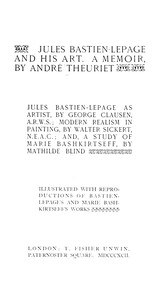
This 1892 volume collects four essays on Jules Bastien-Lepage: a memoir by André Theuriet, an artistic analysis by George Clausen, a treatise on realism by Walter Sickert, and a study of Marie Bashkirtseff by Mathilde Blind. The excerpts reveal contrasting views on the painter's impartial, portrait-like approach to rural subjects, his precise visual method, and his divergence from Millet's more symbolic style.
Read the complete public-domain text at its original source.
Read on Project GutenbergBastien-Lepage's figures, as described in this 1892 collection of essays, do not merely illustrate a scene; they confront the viewer with an unsettling independence. George Clausen observes that the painter's subjects 'convince us of their identity as individuals' to the point where we 'begin to forget what they are doing, and almost to wonder why they are there.' This effect is deliberate: the artist withholds any clue to his own feelings, presenting his models with what Clausen calls 'studied impartiality.' The result is a realism that feels less like storytelling and more like an encounter.
A Painter of Individuals, Not Types
Clausen draws a sharp distinction between Bastien-Lepage and Jean-François Millet, the dominant influence on rural painting. For Millet, 'the subject and type were everything—the individual nothing'; his figures are vehicles for universal sentiment. Bastien-Lepage, by contrast, 'centres in the individual.' His pictures become portraits, even when the ostensible subject is a labourer at work. The attention shifts from the action to the actor, and the viewer is left to wonder at the person's inner life. Clausen admits this creates a 'conflicting element' in the picture—the interest is 'equally divided' between the task and the person performing it. This tension, he suggests, is both a strength and a puzzle.
The Impartial Eye and Its Limits
Clausen praises Bastien-Lepage's 'extraordinary receptive power' and 'unequalled (almost microscopic on occasion) clearness of vision.' The painter's method is one of 'absolute mastery of his material,' yet he suppresses any hint of his own feelings. This impartiality, Clausen argues, is 'the distinct note of all his work.' But he also questions whether such neutrality serves the picture's coherence. With Millet, 'the attention is always concentrated on the business in hand'; there is no ambiguity. Bastien-Lepage's approach, while admirable, risks dividing the viewer's focus. The essay thus offers a nuanced critique, not mere praise.
André Theuriet's Memoir: A Personal Lens
Theuriet opens his memoir with a vivid description of Damvillers, the small town where he first encountered Bastien-Lepage. His prose dwells on the landscape's 'peaceful and rural' character, the 'grey, blue hills' and 'rows of poplars' that break the monotony of fields. This setting, he implies, shaped the painter's vision. Theuriet's account is personal—he recalls spending 'solitary evenings' watching twilight descend—and it grounds the artist's work in a specific place. Unlike Clausen's analytical tone, Theuriet's is evocative, offering a counterpoint that enriches the volume's portrait of the artist.
Sickert and Blind: Expanding the Frame
The volume includes Walter Sickert's essay on 'Modern Realism in Painting' and Mathilde Blind's study of Marie Bashkirtseff, a young Russian painter who admired Bastien-Lepage. While the excerpts do not reveal the full content of these pieces, their presence suggests a broader inquiry into realism's aims and practitioners. Blind's contribution, in particular, connects Bastien-Lepage to a contemporary figure, hinting at a network of artistic influence. Together, the four essays offer multiple perspectives on a single career, allowing the reader to compare how different writers interpret the same body of work.
Readers interested in the mechanics of realist painting will find Clausen's essay especially rewarding for its technical precision and willingness to question the master's choices. Theuriet's memoir provides a sense of place, while Sickert and Blind broaden the discussion. Approach the volume as a conversation among contemporaries, each with a distinct voice and critical agenda.
Sometimes a book stays with you not for its answers but for how gently it holds complexity. That 1892 volume on Bastien-Lepage felt like that—artists circling one man’s quiet gaze, each finding something different. I remembered it flipping through Salt mines and castles: The discovery and restitution of looted European art — Background and Themes, which also lingers on what’s lost and reclaimed in looking. Both leave a soft ache.
There are no reviews for this eBook.
There are no comments for this eBook.
Reader reflection
Take a moment to reflect on this book
Create a short personal record of your experience with this book.
Your progress
0
/
10
2
What was your overall reaction to the book?
3
Would you encourage someone else to read it?
4
How demanding did the text feel?
5
Do you expect to return to this book?
6
What was its emotional impact?
7
What did you think about the pace?
8
Did any part of the book feel personally relevant?
9
What did this book teach you most?
10