1

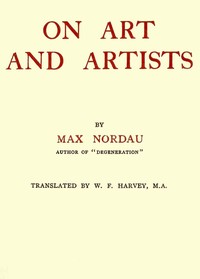
On art and artists — Themes and Context
(0 User reviews)
322
Project Gutenberg
2025
Not confirmed
Art; Degeneration; Art -- France -- History
Readers of public-domain and historical texts
Project Gutenberg digital edition
en
Edition facts
Words
86,962
Reading time
379 min
Text sections
22
The source record for On art and artists — Themes and Context measures this digital text at 86,962 words, 6 hr 19 min estimated reading time, and 22 detected text sections.
The text analysis averages about 24.8 words per sentence, while the detected sections provide another way to judge how the source is divided.
Project Gutenberg metadata also associates the work with “Art,” connecting these edition facts with the source record’s subject description.
Source:
Project Gutenberg record #76748
Nordau's essays on French art argue against 'art for art's sake,' championing a moral and social mission. He dissects painters like Puvis de Chavannes and Eugène Carrière, using sharp, opinionated prose to link artistic style to psychological and cultural forces.
Read the complete public-domain text at its original source.
Read on Project GutenbergMax Nordau opens this collection by dismissing the doctrine of l'art pour l'art as a sign of 'crass ignorance,' grounding his critique in psychology and the history of civilisation. For Nordau, art is never merely decorative; it is a subjective activity rooted in the artist's exceptional sensitivity, and its true value lies in its social and moral mission. Throughout these essays, originally published in 1907, he applies this lens to French painting from the Old Masters to the Symbolists, blending sharp aesthetic judgments with a broader cultural diagnosis.
Nordau's voice is combative and unapologetically opinionated. He praises Eugène Carrière for painting 'souls' and 'feelings,' while dismissing Bastien-Lepage's naturalism as 'abominable.' The reader is offered not a neutral survey but a polemic that insists on art's responsibility to elevate and interpret, not merely copy reality.
The Polemical Opening: Art's Mission vs. Aestheticism
Nordau begins by attacking the notion that art exists solely for beauty. He calls this theory 'false' and a 'hallmark of crass ignorance,' arguing that psychology and history prove art has always served a purpose beyond itself. He traces artistic creation to an 'exceptional sensitiveness' that demands liberation through movement or expression. For the average person, weeping or laughing suffices; for the artist, the emotion must be shaped into a work that communicates to others. This psychological framework allows Nordau to dismiss the l'art pour l'art movement as a denial of art's true function. He insists that even the most subjective creation carries an implicit social dimension, because it arises from a need to externalise inner states. The opening chapter thus establishes a combative tone, positioning the author as a defender of art's ethical and communal responsibilities against what he sees as a decadent retreat into formalism.
Puvis de Chavannes: A Deliverer from Naturalism
In his chapter on Puvis de Chavannes, Nordau presents the painter as a corrective to the naturalism that dominated French art in the 1870s and 1880s. He describes naturalism as 'the negation of all art,' a soulless copying of reality that left the public dissatisfied despite critical praise. Puvis de Chavannes offered an alternative: wall-paintings that revived symbolism, sacred legend, and tradition. Nordau writes that before his pictures 'one could once more dream'—they were 'verse' after 'prose.' Yet Nordau is not uncritical. He notes that in a period of idealism, Puvis would have been merely 'one of the many,' his work marked by 'banality of symbols' and 'impersonality.' The essay balances admiration for Puvis's role as a 'file-leader' against a recognition of his limitations. This nuanced assessment shows Nordau's willingness to praise a corrective trend while still applying his own rigorous standards.
Eugène Carrière and the Art of the Future
Nordau devotes a chapter to Eugène Carrière, whom he elevates as a model for painting's future. He argues that Carrière goes beyond depiction to 'paint souls' and 'feelings,' using fugitive movements, poses, and lines that reveal unconscious moods. The artist's task, in Nordau's view, is to be an 'inspired eye' that selects and interprets, not a 'mechanically reproducing, dead object-glass.' Carrière's work becomes 'an anthology of vision,' where personality is the source of fascination and value. Nordau predicts that painting will evolve toward this 'spiritual art,' where the artist's emotional excavation of optical phenomena takes precedence over mere representation. This section crystallises Nordau's ideal: art that discloses the impulses behind movement and deportment, making 'the inexpressible become an incident.' It is a direct application of his psychological theory to a specific painter, showing how his abstract principles translate into concrete aesthetic preferences.
Diction and Argument: Nordau's Rhetorical Style
Nordau's prose is marked by strong evaluative language and a confrontational stance. He does not hesitate to call a work 'abominable' or a theory 'worthless.' His sentences often build a case through contrast: naturalism versus idealism, prose versus verse, the average man versus the exceptional artist. He uses rhetorical questions and direct addresses to the reader, as when he writes 'Let no one say: “These are trivialities.”' This combative tone serves his argumentative purpose, framing art criticism as a battle between truth and error. Nordau also employs a scientific vocabulary drawn from psychology and physiology, referring to 'psychical processes,' 'glandular activity,' and 'experimental laboratory.' This blend of polemic and pseudo-science gives his essays a distinctive voice—authoritative, impatient, and deeply engaged. Readers should attend to how Nordau's diction itself enacts the mission he demands of art: it is never neutral, always purposeful, and unashamedly partisan.
Nordau's essays reward readers who enjoy strong, opinionated criticism grounded in a coherent system of values. He is not a neutral guide but a polemicist who forces you to take sides. The book is best approached as a document of early twentieth-century aesthetic debate, where psychological theory meets sharp judgments on individual artists. Pay attention to how Nordau's vocabulary—'degeneration,' 'mission,' 'soul'—shapes his evaluations, and consider whether his criteria still hold relevance for contemporary art discourse.
That Nordau book stayed with me because it made me feel that art could carry weight, a sense of duty beyond pretty surfaces. It reminded me of something quieter in Industrial Arts Design A Textbook of Practical Methods for Students, Teachers, and Craftsmen — Background and Themes, where usefulness and beauty aren’t enemies but old friends. It lingered, like a thought you keep turning over softly.
There are no reviews for this eBook.
There are no comments for this eBook.
Reader reflection
Before you leave, reflect on the book
Use these questions to collect your thoughts before moving on.
Your progress
0
/
10
2
How much did you enjoy the reading experience?
3
Would you encourage someone else to read it?
4
How demanding did the text feel?
5
How would you rate its originality?
6
Did the story or argument move comfortably?
7
Which element worked best for you?
8
How strongly did the book affect you emotionally?
9
What is the main idea you are taking away?
10