1

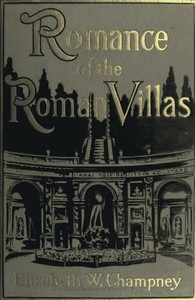
Romance of Roman Villas (The Renaissance) — Context and Discussion
(0 User reviews)
1013
Project Gutenberg
2009
Not confirmed
Renaissance -- Italy; Legends -- Italy; Art -- Italy
Readers of public-domain and historical texts
Project Gutenberg digital edition
en
Edition facts
Words
87,094
Reading time
379 min
Text sections
11
The catalog record for Romance of Roman Villas (The Renaissance) — Context and Discussion provides practical reading context through 87,094 words, 6 hr 19 min estimated reading time, and 11 detected text sections.
The text analysis averages about 25.2 words per sentence, while the detected sections provide another way to judge how the source is divided.
Project Gutenberg metadata also associates the work with “Renaissance -- Italy,” connecting these edition facts with the source record’s subject description.
Source:
Project Gutenberg record #27766
An examination of Renaissance cardinals' villas through their architecture, legends, and art, with a focus on the Este family and poet Torquato Tasso, based on excerpts that blend historical description with fictional dialogue.
Read the complete public-domain text at its original source.
Read on Project GutenbergThe opening pages of Romance of Roman Villas (The Renaissance) immediately establish a tension between architectural description and narrative fiction. The introduction, quoting Walter Thornbury, presents the villas as objects of 'picturesque decay' and frames the book as an inquiry into their 'heyday of joyous revelling.' Yet the excerpts soon shift into a dramatized scene featuring Cardinal Ippolito d'Este, his nieces, and the poet Torquato Tasso. This hybrid form—part historical survey, part romantic dialogue—means the catalog subjects 'Renaissance,' 'Legends,' and 'Art' are not treated as separate topics but interwoven through a single, anecdotal lens.
Cardinals as Patrons and Players
The excerpts repeatedly link villa construction to cardinalatial ambition. Champney writes that 'the young cardinal's first move in the game which he was to play was at all expense to create an impression.' The red hat is described not as an end but as 'a step to the papacy,' and the villas are presented as instruments of political display. This is not a neutral architectural history; the author uses the Este family to illustrate how ecclesiastical wealth funded lavish estates. Cardinal Ippolito d'Este, in the dialogue, complains of his predecessor's failure to reward Ariosto, then schemes to recruit Tasso. The villas thus become stages for patronage and rivalry, not mere buildings.
Fountains, Fables, and the Poet's Ear
A striking passage has the cardinal instructing his listeners to hear in the fountains 'the musical instruments which Boccaccio gave to the Satyrs.' He claims to perceive Arethusa fleeing Alpheus in the organ's roar. This moment reveals the book's method: legends are not recounted separately but voiced by characters who treat myth as living sound. The cardinal laments that no contemporary poet can 'interpret the poetry which I feel here but cannot express,' and his niece suggests that Bernardo Tasso's son—Torquato—heard the fountains as a child. The excerpts thus position Tasso as the figure who can translate villa atmosphere into verse, blending the catalog subject 'Legends' with a specific literary biography.
The Villa as a Setting for Dialogue
Rather than a straightforward guide, the excerpts present a sustained conversation among Cardinal Ippolito, the Duchess of Urbino, and Leonora. They discuss Ariosto's governorship of Garfagnana, Tasso's epic on Jerusalem, and the cardinal's wish for a pastoral poem. The setting—a villa garden with fountains and a view of St. Peter's—is described through their remarks, not through detached observation. This technique makes the architecture secondary to the human interactions it hosts. The catalog subject 'Art' appears only indirectly, as in the reference to Pope Julius II viewing the Apollo Belvedere in an illustration caption. The text itself prioritizes anecdote over systematic art analysis.
Readers should approach this book expecting a blend of historical anecdote and fictionalized conversation rather than a systematic architectural study. The excerpts suggest that Champney uses the villa as a stage for dramatizing Renaissance patronage, literary ambition, and the persistence of classical myth. The incomplete nature of the excerpts leaves unclear how much of the book follows this pattern versus offering more conventional description. Pay attention to how the dialogue carries the argument—the characters often voice the historical analysis themselves.
This talk of the Este villas and Tasso’s restless ghosts brought me back to a summer afternoon, rereading The Stones of Venice, Volume 3 (of 3) — Background and Themes. There, too, grandeur felt heavy, almost haunted. Both books whisper about beauty that outlives its makers, leaving only stone and longing—that same ache of something splendid, quietly gone.
There are no reviews for this eBook.
There are no comments for this eBook.
Reader reflection
Take a moment to reflect on this book
Create a short personal record of your experience with this book.
Your progress
0
/
10
2
How did the book work for you overall?
3
Would you pass this book on to a friend?
4
How demanding did the text feel?
5
Did the book give you something worth debating?
6
Was the book easy to understand?
7
Could you see yourself revisiting this book?
8
Which element worked best for you?
9
What changed or sharpened your thinking?
10