1

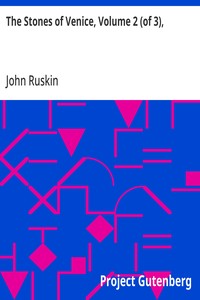
The Stones of Venice, Volume 2 (of 3), — Text and Context
(0 User reviews)
476
Project Gutenberg
2009
Not confirmed
Architecture -- Italy -- Venice
Readers of public-domain and historical texts
Project Gutenberg digital edition
en
Edition facts
Words
149,867
Reading time
652 min
Text sections
15
The catalog record for The Stones of Venice, Volume 2 (of 3), — Text and Context provides practical reading context through 149,867 words, 10 hr 52 min estimated reading time, and 15 detected text sections.
The text analysis averages about 33.4 words per sentence, while the detected sections provide another way to judge how the source is divided.
Project Gutenberg metadata also associates the work with “Architecture -- Italy -- Venice,” connecting these edition facts with the source record’s subject description.
Source:
Project Gutenberg record #30755
John Ruskin's second volume examines Byzantine and Gothic architecture in Venice, focusing on St. Mark's, the Ducal Palace, and the nature of Gothic design. The excerpts reveal his moral and aesthetic arguments, linking architectural ornament to spiritual and social conditions.
Read the complete public-domain text at its original source.
Read on Project GutenbergJohn Ruskin opens his second volume with a striking claim: Gothic architecture did not originate from the imitation of vegetation, but gradually developed into a resemblance to natural forms. He argues that this evolution reflects a shift from 'massy and mountainous strength' to a more refined, organic expression, marking a 'prophecy of the development of the entire body of the natural sciences.' This volume, covering the Byzantine and Gothic periods, includes detailed chapters on Torcello, Murano, St. Mark's, and the Ducal Palace, as well as the influential essay 'The Nature of Gothic.'
Ruskin's prose is dense with moral conviction, treating architectural details as evidence of the builders' temper and society's health. The excerpts show him distinguishing between the 'affectionate observation' of vegetation in Gothic design and the mere structural necessity of earlier styles. He insists that the 'green herb' is essential to spiritual life, and that architecture's highest honor is to 'bear the image' of nature.
The Moral Weight of Ornament
Ruskin treats architectural ornament not as decoration but as a direct index of cultural and spiritual condition. In the excerpts, he contrasts the 'habitual tenderness' of Gothic carvers with the 'axe-hewn' strength of earlier builders, arguing that the shift toward naturalistic detail signals a 'more tranquil and gentle existence.' He explicitly rejects the theory that Gothic forms derived from vegetation, calling it 'idle' and 'vain,' yet he values the resemblance as 'instructive' because it reveals the builders' temper. This moral framework pervades the volume: every 'discriminating and delicate touch of the chisel' is, for Ruskin, a sign of broader intellectual and social development.
Architecture as Historical Evidence
The catalog subject 'Architecture -- Italy -- Venice' understates the scope of Ruskin's project. He uses buildings as primary documents, reading them for clues about the society that produced them. In the excerpts, he links the 'careful distinction of species' in Gothic carving to the rise of natural science, medicine, and 'domestic wisdom.' The volume's structure—moving from Byzantine to Gothic palaces, then to the Ducal Palace—suggests a narrative of decline or transformation. Ruskin's appendixes, including notes on tides, pulpits, and inscriptions, further indicate his archaeological method. The excerpts do not reveal his conclusions about later periods, but they show his conviction that architecture embodies history.
The Rhetoric of the Sea Stories
The volume's subtitle, 'The Sea Stories,' hints at a unifying theme that the excerpts only partially illuminate. Ruskin's references to 'the sound of war' and 'the dead field-flowers, long trodden down in blood' suggest a martial backdrop to Venice's architectural development. He describes Gothic architecture as arising 'in massy and mountainous strength, axe-hewn, and iron-bound,' evoking a world of conflict. The 'sea stories' may refer to Venice's maritime context, but the excerpts focus inland, on stone and vegetation. Readers should note that the volume's full argument likely ties these elements together, though the provided text does not complete that arc.
Readers approaching this volume should be prepared for Ruskin's distinctive blend of technical description, moral philosophy, and impassioned prose. The excerpts reveal a writer who sees architecture as a living record of human values, not a mere collection of styles. Pay attention to his recurring contrasts—between strength and refinement, necessity and beauty—as they structure his argument across chapters. The appendixes and plates mentioned in the contents are integral to his method, offering evidence for claims made in the main text.
Reading Ruskin’s chapters on St. Mark’s, I kept thinking how he treats ornament as a kind of slow, patient logic—each stone holding its place in a larger argument. That same quiet certainty came back to me while skimming Plato's Doctrine Respecting the Rotation of the Earth and Aristotle's Comment Upon That Doctrine — A Closer Reading, as if both writers were simply trusting their own turning minds.
There are no reviews for this eBook.
There are no comments for this eBook.
Reader reflection
Take a moment to reflect on this book
Create a short personal record of your experience with this book.
Your progress
0
/
10
2
Did this book hold your interest?
3
How likely are you to recommend this book?
4
How demanding did the text feel?
5
Do you expect to return to this book?
6
What did you think about the pace?
7
Would you like to discuss this book with someone?
8
Did you relate to its people, ideas, or situations?
9
Which lesson or insight stayed with you?
10