1

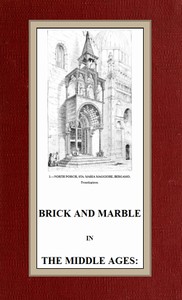
Brick and Marble in the Middle Ages: Notes of Tours in the North of Italy — Story, Setting & Ideas
389
0
Project Gutenberg
2014
Architecture, Gothic; Architecture, Medieval; Architecture -- Italy
Readers of public-domain and historical texts
Project Gutenberg digital edition
en
Edition facts
Words: 139,961
Reading time: 609 min
Text sections: 16
Source:
Project Gutenberg record #46326
Street's architectural notes from mid-19th-century tours of northern Italy, focusing on Gothic brick and marble work in cities like Venice, with precise observations on details such as dentil mouldings, ogee arches, and irregular palace designs.
Editorial Edition Score
4.9/5
★★★★★
★★★★★
Calculated from edition completeness, EPUB availability, text structure and catalogue metadata. Not a user rating.
Edition quality
Street opens his account of Venetian domestic architecture by contrasting the Ducal Palace with the city's other buildings, noting a 'great gap' in quality. He then guides the reader through narrow canals, stopping at specific fragments: an archway near the Ponte del Paradiso, a unique diamond-patterned marble veneer, and the irregular Palazzo Cicogna. His descriptions are tactile and precise, dwelling on mouldings, tracery, and the interplay of materials.
Diction and the Architect's Eye
Street's vocabulary is that of a working architect. He uses terms like 'dentil-moulding,' 'billeted string-course,' and 'incrusted circles' without glossing them, assuming a reader familiar with Gothic construction. His prose is brisk and evaluative: a detail is 'pure and good,' a window 'conspicuous from its size and the peculiarity of its tracery.' He does not merely describe; he judges, ranking buildings by 'merit' and noting when a feature is 'unique' or 'precious.' This technical diction, combined with a personal tone—'I remember gratefully'—gives the text the feel of a field notebook, not a guidebook.
Dialogue with the Reader
Street frequently addresses the reader directly, using the first-person plural: 'let us now go in search of other palaces'; 'we will not attempt to take the buildings as they come.' This creates a shared journey, as if the reader is beside him in a gondola. He also uses imperatives—'stop in this narrow canal'—and assumes the reader's visual attention: 'I trust that my sketch is clear enough.' These rhetorical moves transform the text from a dry catalogue into an animated tour, where the architect's enthusiasm and frustration (as when he notes the 'great gap' between the Ducal Palace and everything else) become part of the experience.
Structure: From General to Particular
Street organizes his observations by moving from broad comparisons to minute details. In the Venetian section, he first establishes the Ducal Palace as the benchmark, then acknowledges the 'general similarity' of other palaces, and finally isolates specific anomalies: the arch at Ponte del Paradiso, the diamond veneer, the irregular Palazzo Cicogna. This structure mirrors the architect's analytical process—starting with an overall impression, then zooming in on what breaks the pattern. The result is a narrative of discovery, where each building is a puzzle to be examined for its unique solution to the problems of Gothic design.
Recurring Details: Mouldings and Materials
Two motifs recur throughout Street's notes: the 'dentil-moulding' and the use of marble incrustation. He traces the dentil to its origin in San Marco's borders, then follows its migration to secular buildings, where it 'defines all the leading architectural features.' Similarly, he notes marble veneers—'incrusted circles,' diamond patterns—as a Venetian specialty. These details are not mere decoration; for Street, they are the DNA of a building's style. When he finds a 'unique example' of diamond veneer, he records it with the satisfaction of a naturalist spotting a rare species. His eye is always on the material fact, the specific joint or pattern that distinguishes one palace from another.
Street's notes reward the reader who reads slowly, with a plan or photograph in hand. His judgments are personal and his terminology exacting, but the book's value lies in its granular attention to the physical fabric of buildings—the way a moulding turns a corner, the rhythm of a window arcade. For those willing to follow his gaze, it offers a masterclass in looking at Gothic architecture.
Reader reflection
What was your reading experience?
Capture what you thought, learned, and would like to remember.
Your progress
0
/
10
2
How did the book work for you overall?
3
Would you encourage someone else to read it?
4
Did the language feel accessible?
5
Did the book offer a fresh perspective?
6
Could you follow the author’s main argument?
7
Would this book work well in a reading group?
8
Which element worked best for you?
9
Which lesson or insight stayed with you?
10