1

Brief guide — Reading Companion
703
0
Project Gutenberg
2021
National Gallery of Art (U.S.); Art museums -- Washington (D.C.) -- Guidebooks
Readers of public-domain and historical texts
Project Gutenberg digital edition
en
Edition facts
Words: 13,951
Reading time: 61 min
Text sections: 2
Source:
Project Gutenberg record #66746
This editorial note examines the National Gallery of Art's Brief Guide, focusing on its descriptive diction, structural choices, and the interplay between institutional history and individual artworks. Observations are drawn from the text's treatment of architecture, collection organization, and specific gallery entries.
Editorial Edition Score
4.5/5
★★★★★
★★★★★
Calculated from edition completeness, EPUB availability, text structure and catalogue metadata. Not a user rating.
Edition quality
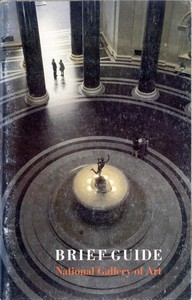
The Brief Guide opens not with a painting but with the building itself: a marble structure 780 feet long, its columns from Tuscany, its floors from Vermont and Tennessee. The prose lingers on materials—rose-white Tennessee marble, Alabama Rockwood stone, Italian travertine—as if the building were itself a collected object. This attention to physical substance sets the tone for a guide that treats the museum as both container and content.
Architecture as Prologue
The guide devotes its first substantive paragraphs to the building’s construction history, naming John Russell Pope as architect and detailing the provenance of each stone. This is not mere background; it establishes a pattern of provenance that will recur in the gallery entries. The Rotunda’s green marble from Vermont and gray marble from Tennessee are described with the same specificity later applied to pigments and brushwork. The building is presented as a deliberate collection of materials, curated like the art it houses. The text notes that the entire structure is “air-conditioned and humidity-controlled throughout the year,” a practical detail that underscores the institution’s role as conservator. This opening section frames the Gallery as a physical entity before it becomes a collection of paintings.
The Collection as Narrative Sequence
The table of contents lists collections by region and period: Florentine and Central Italian Art, Venetian and North Italian Art, Flemish and German Art, and so on. This arrangement implies a chronological and geographical progression, but the excerpts reveal a more nuanced structure. The American section, for instance, moves from Copley’s Watson and the Shark (1778) to Stuart’s The Skater (1782) to Cole’s The Voyage of Life: Childhood (1842) to Hicks’s The Cornell Farm (1848) to Whistler’s The White Girl (1862). The sequence is roughly chronological, but the guide’s commentary emphasizes thematic connections: Copley’s “sense of immediacy” as an American innovation, Stuart’s “free-spirited freshness,” Cole’s symbolic landscapes, Hicks’s “naïve” patterning, Whistler’s tonal experiment. Each entry builds a case for American art’s distinct contributions, from realism to abstraction.
Diction of Description: Precision and Interpretation
The guide’s language is consistently precise, often blending objective description with interpretive cues. Of Copley’s Watson and the Shark, it notes the “vivid emotions” of the rescuers—“cowardice, fear, compassion”—and the “helpless fright of the boy.” These are not neutral observations; they guide the viewer’s emotional response. For Whistler’s The White Girl, the text explains that the work is “not intended as a portrait” but as an exploration of “a single tone—white.” It then points to “the fullness of the girl’s lips, the thick richness of her chestnut hair, and her wide blue eyes” as a “subtle but uneasy contrast to the purity of the white color.” This attention to tension—between color and form, between intention and effect—recurs throughout the entries. The guide does not merely label; it teaches a way of seeing.
The Institutional Voice: Authority and Accessibility
The guide’s tone is authoritative yet accessible, a balance achieved through straightforward syntax and avoidance of jargon. The opening statement—“The National Gallery of Art belongs to all the people of the United States of America”—establishes a democratic ethos. Subsequent descriptions of governance (the Board of Trustees includes the Chief Justice) and funding (public appropriation plus private gifts) reinforce the idea of a public trust. Yet the guide never lectures; it assumes an intelligent but unspecialized reader. When discussing Hicks’s The Cornell Farm, it notes that the artist “lacked formal artistic schooling” and was “a sign and coach painter,” but it does not condescend. Instead, it highlights the “decorative patterning” and “study in contrast” that make the work noteworthy. This balance—between institutional authority and reader-friendly clarity—is the guide’s defining stylistic feature.
The Brief Guide rewards a careful reading of its descriptive choices. Notice how often the text pairs a material fact with an interpretive claim: the building’s marble is both a physical detail and a symbol of permanence; a painting’s composition is both a formal arrangement and an emotional trigger. This dual attention—to the object and to its effect—is the guide’s quiet pedagogy. For readers exploring the Gallery, the guide offers not just a map but a method of looking.
Reader reflection
Take a moment to reflect on this book
Create a short personal record of your experience with this book.
Your progress
0
/
10
2
Did this book hold your interest?
3
Would you recommend this book to another reader?
4
How much effort did this book require?
5
How would you describe its reading pace?
6
How did the reading compare with what you expected?
7
Would a second reading be valuable?
8
How strong was your personal connection to the text?
9
In one sentence, what did you learn?
10