1

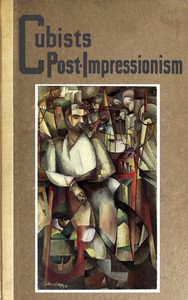
Cubists and Post-Impressionism — Key Ideas to Explore
(0 User reviews)
1747
Project Gutenberg
2021
Not confirmed
Post-impressionism (Art); Cubism; Impressionism (Art) -- 1910-
Readers of public-domain and historical texts
Project Gutenberg digital edition
en
Edition facts
Words
74,955
Reading time
326 min
Text sections
15
The source record for Cubists and Post-Impressionism — Key Ideas to Explore measures this digital text at 74,955 words, 5 hr 26 min estimated reading time, and 15 detected text sections.
The text analysis averages about 21.0 words per sentence, while the detected sections provide another way to judge how the source is divided.
Project Gutenberg metadata also associates the work with “Post-impressionism (Art),” connecting these edition facts with the source record’s subject description.
Source:
Project Gutenberg record #64936
Eddy's 1914 study examines Cubism and Post-Impressionism through a collector's lens, blending analysis of theory, form, and the spiritual aims of artists like Kandinsky and Picasso, with a focus on the tension between technical skill and inner expression.
Read the complete public-domain text at its original source.
Read on Project GutenbergArthur Jerome Eddy, a Chicago collector and author of earlier works on Whistler, opens Cubists and Post-Impressionism not with a manifesto but with a sensation—the public outcry at the 1913 Armory Show. From the first chapter, Eddy positions himself as an interpreter rather than a partisan, aiming to explain the new art to an American audience still reeling from the shock of Matisse's Blue Nude and Duchamp's Nude Descending a Staircase. The book's structure mirrors this explanatory intent: it moves from the initial scandal through definitions of Post-Impressionism, Fauvism, and Cubism, then into more speculative territory with chapters on Kandinsky's 'Color Music' and the Futurists. Eddy's voice is that of a well-read enthusiast, weaving quotations from artists and critics into a narrative that treats the new movements as serious intellectual developments rather than mere provocations.
Eddy's Method: Quotation as Argument
Eddy builds his case largely through extended quotations from artists and their defenders. The chapter on Kandinsky, for instance, reproduces a long letter in which the painter dismisses the notion that modernists 'paint that way because they can't draw.' Kandinsky insists that technical facility is easily acquired—'even a poodle-dog might learn how to draw'—but that true art requires an 'inner self' expressed in an 'entirely original form.' Eddy lets these statements stand with minimal commentary, trusting the reader to weigh the artist's own words. This method gives the book a documentary quality: it preserves the voices of the movement's protagonists as they argued for their work in the early 1910s. The result is less a unified thesis than a mosaic of perspectives, with Eddy acting as curator rather than critic.
The Spiritual in Matter: Kandinsky's Influence
Eddy devotes considerable space to Wassily Kandinsky, whose theoretical writings—particularly the essay 'On the Question of Form' in Der Blaue Reiter—are paraphrased at length. Kandinsky's central claim, as Eddy presents it, is that 'the creative spirit is hidden in the matter, behind the material manifestation through which it must make itself known.' The artist's task is to penetrate the 'material envelope' and convey a spiritual content that most viewers cannot see. Eddy connects this to a broader critique of the nineteenth century as 'a century of materialism,' suggesting that modern art's apparent strangeness is a necessary response to a culture that has lost sight of inner truths. This section of the book shifts from descriptive analysis to something closer to advocacy, as Eddy aligns himself with Kandinsky's vision of art as a vehicle for spiritual renewal.
Pace and Structure: From Scandal to Theory
The book's fifteen chapters move at an uneven pace, reflecting Eddy's dual role as journalist and theorist. Early chapters—'A Sensation,' 'Post-Impressionism,' 'Les Fauves'—are brisk and anecdotal, recounting the public's hostile reception and the critics' dismissive labels. But as the book progresses, the tempo slows: 'What is Cubism?' and 'The Theory of Cubism' are dense with philosophical exposition, while 'Color Music' and 'Esoragoto' venture into speculative territory. The final chapters on Futurism and sculpture return to a more reportorial tone, cataloging works and exhibitions. This variation in pace mirrors the subject itself: the initial shock of the new gives way to the harder work of understanding its principles. Eddy does not resolve the tension between sensation and theory; instead, he lets the reader experience both.
Eddy's book is best read as a contemporary document rather than a definitive history. Its value lies in the immediacy of its sources—the letters, manifestos, and exhibition reviews that Eddy gathered while the debates were still ongoing. Readers interested in the Armory Show's aftermath or the early reception of European modernism in America will find a wealth of primary material, though they should supplement it with later scholarship. Eddy's own biases are clear: he champions the spiritual ambitions of Kandinsky and the formal innovations of Picasso while dismissing the Futurists' more aggressive posturing. The book remains a vivid snapshot of a moment when the meaning of modern art was still very much in dispute.
I keep thinking about how Eddy saw painting as a struggle between craft and feeling, and it made me remember another quiet book, Photographic Reproduction Processes — Themes and Context, where the mechanical act of copying somehow holds its own kind of soul. It lingered the way some afternoons do—not loud, just present. Strange how technique can whisper. That stayed with me.
There are no reviews for this eBook.
There are no comments for this eBook.
Reader reflection
Before you leave, reflect on the book
Use these questions to collect your thoughts before moving on.
Your progress
0
/
10
2
What was your overall reaction to the book?
3
Would you recommend this book to another reader?
4
Did the language feel accessible?
5
How strongly did the book affect you emotionally?
6
Was the book what you thought it would be?
7
What was the strongest part of the book?
8
Did the story or argument move comfortably?
9
What changed or sharpened your thinking?
10