1

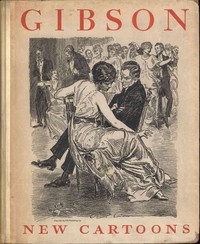
Gibson: New Cartoons; A book of Charles Dana Gibson's latest drawings — Text and Context
9
0
Project Gutenberg
2020
Caricatures and cartoons -- United States; American wit and humor, Pictorial; Drawing, American
Readers of public-domain and historical texts
Project Gutenberg digital edition
en
Edition facts
Words: 4,304
Reading time: 19 min
Text sections: 1
Source:
Project Gutenberg record #62865
A 1916 collection of Charles Dana Gibson's single-panel cartoons, pairing laconic captions with social satire. The excerpts reveal recurring themes of marriage, class, and gender roles, often through deadpan dialogue. The catalog subjects (caricature, humor, drawing) accurately reflect the work, though the 'Architecture' category seems misapplied.
Editorial Edition Score
4.4/5
★★★★★
★★★★★
Calculated from edition completeness, EPUB availability, text structure and catalogue metadata. Not a user rating.
Edition quality
Charles Dana Gibson's New Cartoons (1916) collects single-panel drawings originally published in Life magazine. The excerpts show a consistent format: a detailed illustration paired with a short, often deadpan caption. Gibson's humor relies on understatement and ironic reversal, as when a wife tells her husband, before marriage you were 'a man of a thousand,' but now she cannot forget 'the other nine hundred and ninety-nine.' The drawings themselves are not reproduced in this text, only the captions and occasional descriptive titles, so the reader must imagine the visual component.
Marriage as a Recurring Punchline
Many captions revolve around marital dynamics, often portraying husbands as henpecked or foolish. In one, a husband complains about his wife flirting with old sweethearts; she retorts that he was 'a man of a thousand' before marriage, but she cannot forget 'the other nine hundred and ninety-nine.' Another shows a wife who 'came out ahead' in a fight because her husband 'accepted my apology.' A third caption has a visitor saying he acts 'just like one of the family' at a friend's house, meaning he is 'just as much afraid of my wife as I am.' These jokes rely on a shared understanding of marriage as a battle of wits, with the wife typically winning.
Class and Social Pretension
Gibson also skewers class distinctions and social climbing. In 'Botany in the Bowery,' a girl admits she got flowers 'off a lady,' not from a tree or bush. A mistress complains of a smell; the maid blames it on 'next door.' A woman tired of settlement work finds poor people 'so monotonous.' The 'Advice to the Mentally Feeble' series offers sardonic tips: 'Keep out of politics,' 'By all means marry for a home,' 'Go back to the stable as soon as possible.' These suggest a cynical view of social reform and the supposed wisdom of the upper classes.
The Limits of the Text-Only Record
Because this edition reproduces only captions and titles, the reader must infer the visual humor. For example, 'When Grandpa Thinks of His Mother' likely shows an elderly man's expression, but the caption alone does not convey the drawing. Similarly, 'The Latest Craze' has a man whispering that his dog 'thinks he's a bulldog'—the joke depends on the dog's appearance. The catalog subject 'Drawing, American' is accurate, but the category 'Architecture' seems unrelated to the content. The excerpts offer no evidence of architectural themes; the misclassification may stem from the book's physical format or original library cataloging.
Readers approaching this text-only edition should remember that Gibson's cartoons were designed as visual-verbal hybrids. The captions are punchlines without setups; the drawings would supply context, character, and timing. To appreciate the humor fully, one might seek out the original illustrated versions. The collection offers a snapshot of early twentieth-century American social attitudes, filtered through Gibson's distinctive, often wry perspective.
Reader reflection
Before you leave, reflect on the book
Use these questions to collect your thoughts before moving on.
Your progress
0
/
10
2
How did the book work for you overall?
3
Would you pass this book on to a friend?
4
What was the reading difficulty like?
5
Was the book what you thought it would be?
6
Which element worked best for you?
7
How personally connected did you feel to the book?
8
How did the pace of the book feel?
9
What did this book teach you most?
10