1

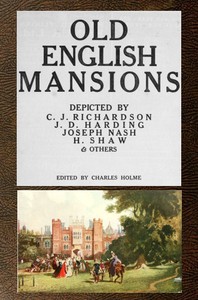
Old English Mansions — Story, Setting & Ideas
(0 User reviews)
866
Project Gutenberg
2018
Not confirmed
Architecture, Domestic -- England
Readers of public-domain and historical texts
Project Gutenberg digital edition
en
Edition facts
Words
17,042
Reading time
75 min
Text sections
3
For Old English Mansions — Story, Setting & Ideas, the stored edition analysis reports 17,042 words, 1 hr 15 min estimated reading time, and 3 detected text sections.
The text analysis averages about 21.8 words per sentence, while the detected sections provide another way to judge how the source is divided.
Project Gutenberg metadata also associates the work with “Architecture, Domestic -- England,” connecting these edition facts with the source record’s subject description.
Source:
Project Gutenberg record #58218
An editorial note on the language, narrative voice, and pace in Alfred Yockney's 1915 survey of English country houses, illustrated by Nash, Harding, and Richardson, focusing on the tension between architectural description and historical anecdote.
Read the complete public-domain text at its original source.
Read on Project GutenbergAlfred Yockney's Old English Mansions (1915) moves between two distinct registers: a cataloguer's precision when describing architectural features and a storyteller's warmth when recounting the lives once lived within those walls. The prose is neither dry nor florid; it shifts pace noticeably, lingering on a carved chimney-piece or a plaster ceiling, then accelerating through a list of destroyed houses. This editorial note examines how Yockney's language, narrative voice, and changes in pace shape the reader's experience of the text.
A Voice Between Guide and Elegist
Yockney adopts the tone of a knowledgeable cicerone, but one who is acutely aware of loss. He writes of mansions that are “but shadows of their former selves” and notes that thirteen of the houses described by S. C. Hall had been destroyed by fire. The voice is not sentimental; it is matter-of-fact, yet the accumulation of such statements creates an undercurrent of melancholy. When he mentions that Kirby Hall “came into the market” in 1913, the phrasing is neutral, but the context—a book devoted to preserving these buildings in illustration—gives the remark weight. The narrator rarely uses the first person, preferring the collective “we” (“we should be and are proud”), which aligns the reader with a shared cultural heritage.
Pace: From Measured Description to Urgent Catalogue
The book's rhythm is set by its alternating modes. In descriptive passages, the sentences are long and periodic, as when Yockney writes of Haddon Hall “dating from Plantagenet times, or earlier” and offering “an almost unrivalled opportunity to study the ideals of various periods.” Here the pace is deliberate, matching the act of architectural observation. But when he turns to losses—the fire at Crewe Hall, the sale of Kirby Hall—the sentences shorten and the tone becomes more urgent. The phrase “no fewer than thirteen” is followed by a rapid enumeration of threats: “other accidents will rob the country of many more.” This shift in pace mirrors the tension between preservation and decay that runs through the work.
Language of Attribution and Uncertainty
Yockney is careful with attribution, noting that questions such as “whether John Thorpe built this or that house” or “whether Inigo Jones did or did not design portions of famous buildings” are “pleasant exercises in deduction.” This language acknowledges the limits of historical knowledge without undermining the value of the buildings. The repeated use of “whether” and “or” creates a pattern of hypothesis, inviting the reader to participate in the scholarly game. At the same time, Yockney insists on the “sum total of achievement” as the main consideration, steering the focus away from individual genius toward collective craftsmanship. This balanced phrasing—neither dogmatic nor vague—characterizes the book's approach to architectural history.
Readers approaching Old English Mansions will find that its value lies not only in the illustrations but in the way Yockney's prose mediates between the permanence of stone and the fragility of memory. Pay attention to the shifts in sentence length and the recurring motifs of fire, sale, and decay; they reveal a subtext of anxiety beneath the surface of antiquarian appreciation.
There’s something peaceful in how Yockney lets the old houses breathe, pausing between stone and story, as if time itself is a room we can wander through. I was reminded of that same quiet patience in The Stones of Venice, Volume 2 (of 3), — Text and Context, where every arch seems to hold its own long-morning light. Both feel less like tours, more like sitting down beside an old friend who remembers.
There are no reviews for this eBook.
There are no comments for this eBook.
Reader reflection
Before you leave, reflect on the book
Use these questions to collect your thoughts before moving on.
Your progress
0
/
10
2
Did this book hold your interest?
3
Would you encourage someone else to read it?
4
How easy was the book to follow?
5
How understandable was the text?
6
How useful were the ideas in this book?
7
Did this book create an emotional response?
8
Did any part of the book feel personally relevant?
9
Which lesson or insight stayed with you?
10