1

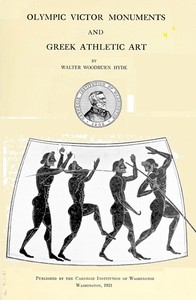
Olympic Victor Monuments and Greek Athletic Art — Story, Setting & Ideas
(0 User reviews)
54
Project Gutenberg
2020
Not confirmed
Sculpture, Greek; Sports -- Greece; Olympics
Readers of public-domain and historical texts
Project Gutenberg digital edition
en
Edition facts
Words
219,616
Reading time
955 min
Text sections
44
This digital edition of Olympic Victor Monuments and Greek Athletic Art — Story, Setting & Ideas is described by source-level measurements including 219,616 words, 15 hr 55 min estimated reading time, and 44 detected text sections.
The text analysis averages about 11.2 words per sentence, while the detected sections provide another way to judge how the source is divided.
Project Gutenberg metadata also associates the work with “Sculpture, Greek,” connecting these edition facts with the source record’s subject description.
Source:
Project Gutenberg record #61792
An archaeological reconstruction of Olympic victor statues, analyzing their poses, bases, and placement in the Altis at Olympia, based on Pausanias, inscriptions, and surviving fragments.
Read the complete public-domain text at its original source.
Read on Project GutenbergWalter Woodburn Hyde’s study reconstructs the lost monuments of Olympic victors by cross-referencing the descriptive catalogue of Pausanias with surviving statue bases and literary epigrams. The work is organized around the physical layout of the Altis, the sacred grove at Olympia, where hundreds of bronze and marble statues once stood. Hyde groups the monuments chronologically and topographically, tracing how later statues filled gaps around the temple of Zeus and the Heraion. The analysis extends to poses inferred from footmarks on bases, and to the head of a marble statue attributed to Lysippos, which Hyde claims to have identified among Olympia finds.
Pausanias as a Topographical Source
Hyde relies heavily on Pausanias’ Description of Greece, Books V–VI, which catalogues victor statues in the Altis. He notes that Pausanias mentions 187 victors with 192 monuments, but explicitly selects only those “who had some title to fame or whose statues were better made.” This selectivity means the catalogue is incomplete; many statues known from inscriptions are omitted. Hyde uses Pausanias’ spatial references—such as “near the Bull,” “around the Victory,” or “along the South Altis wall”—to map the distribution of statues across four chronological phases. The earliest group, from the seventh to fifth centuries B.C., clustered near the Heraion and the temple of Zeus. Later Hellenistic statues spread to the western and northern sides of the temple, following the construction of the Philippeion and Leonidaion.
Reconstructing Poses from Bases
A key method in the book is the analysis of footmarks preserved on statue bases. Hyde explains that the position and orientation of the feet—whether parallel, one advanced, or both turned—indicate the stance of the missing figure. For example, a base with one foot slightly ahead suggests a striding or lunging pose, common for boxers and pancratiasts. He also compares these marks with descriptions in epigrams and with surviving Roman copies. The study includes a marble head from Olympia (the frontispiece) that Hyde attributes to Lysippos, based on its style and the presence of a base nearby. This fragment is one of the few physical remnants he connects directly to a named sculptor.
Chronological Grouping of Monuments
Hyde divides the statues into four periods: (1) from the earliest games to the Persian Wars (c. 776–480 B.C.), (2) from the Persian Wars to the battle of Aigospotamoi (480–404 B.C.), (3) from Aigospotamoi to the birth of Alexander (404–356 B.C.), and (4) after Alexander (356 B.C. onward). For each period, he lists the approximate number of statues and their locations. The third period, for instance, saw thirty-six statues fill intervals among older ones, with fifteen near the Heraion. The latest statues mentioned by Pausanias date to the early second century B.C., though inscriptions show that victor monuments continued into the third century A.D. Hyde does not speculate on why Pausanias stopped at that point, but notes the discrepancy.
Literary and Epigraphic Evidence
Beyond Pausanias, Hyde draws on the elder Pliny’s Natural History (Books XXXIV–XXXVI), which lists Greek sculptors and their works, and on epigrams from the Greek Anthology that match inscriptions on statue bases. He treats Pliny’s account as “uncritical and often untrustworthy” but still a major source. The epigrams provide names of victors, events, and sometimes the sculptor. Hyde also uses the positions of inscribed bases found at Olympia to place statues not recorded by Pausanias. For example, he groups statues by family or hometown: the Diagorids (boxers) stood near Euthymos, and Spartans near Chionis. This clustering reflects both the organization of the Altis and the social networks of the athletes.
Readers should approach this work as a technical archaeological treatise rather than a narrative history. Hyde’s reconstructions are cautious, often noting where evidence is meager. The book is most valuable for its systematic use of Pausanias’ topography and the physical remains of bases. Those interested in the development of Greek athletic sculpture or the layout of Olympia will find a dense but rewarding analysis, grounded in early twentieth-century scholarship.
I keep thinking about how those victor statues stood in the Altis, their poses echoing the exact moment of triumph, frozen for centuries. It made me wonder about how we remember glory at all. There’s a quiet companion to that feeling in The Arts in the Middle Ages and at the Period of the Renaissance — Key Ideas to Explore, which lingers on how art holds a culture’s inner life long after the noise fades.
There are no reviews for this eBook.
There are no comments for this eBook.
Reader reflection
Take a moment to reflect on this book
Create a short personal record of your experience with this book.
Your progress
0
/
10
2
What was your overall reaction to the book?
3
Would you encourage someone else to read it?
4
How easy was the book to follow?
5
Did any part of the book stay with you emotionally?
6
What was the strongest part of the book?
7
Did the book give you something worth debating?
8
Could you see yourself revisiting this book?
9
Which lesson or insight stayed with you?
10