1

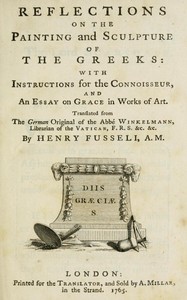
Reflections on the painting and sculpture of the Greeks — Story, Setting & Ideas
9
0
Project Gutenberg
2020
Art, Greek; Aesthetics -- Early works to 1800; Art -- Philosophy
Readers of public-domain and historical texts
Project Gutenberg digital edition
en
Edition facts
Words: 45,627
Reading time: 199 min
Text sections: 8
Source:
Project Gutenberg record #61317
Henry Fuseli's 1765 translation of Winckelmann's treatise on Greek art, arguing for imitation of ancient models. The text shifts from lofty aesthetic theory to detailed discussions of athletic practice, revealing tensions between ideal beauty and physical evidence.
Editorial Edition Score
4.7/5
★★★★★
★★★★★
Calculated from edition completeness, EPUB availability, text structure and catalogue metadata. Not a user rating.
Edition quality
Henry Fuseli's 1765 translation of Johann Joachim Winckelmann's Reflections on the Painting and Sculpture of the Greeks opens with a bold claim: Greek taste was not only original but peculiar to its climate, and the only path to modern greatness lies in imitating the ancients. The translator's own dedication to Lord Scarsdale, thanking him for providing an "Asylum to a Stranger," hints at the cultural displacement that colors this work—a German treatise rendered into English by a Swiss-born artist-scholar. Winckelmann's prose moves between sweeping declarations about nature and minute observations on Greek athletic practices, creating a distinctive rhythm that alternates between the ideal and the empirical.
The Voice of the Connoisseur
Winckelmann writes with the authority of a connoisseur who expects his reader to share his reverence for Greek art. He invokes Nicomachus's retort to a critic of Zeuxis's Helen—"Take my eyes, and she will appear a goddess"—as a model for how the initiated should view ancient works. This rhetorical strategy positions the text as a guide for those who already possess taste, not a primer for beginners. The translator's preface reinforces this: Fuseli speaks of "your Lordship's accurate Judgment, and fine Taste" as if the reader is already among the elect. The prose is dense with classical references, from Plato to Homer, and assumes familiarity with artists like Michael Angelo, Raphael, and Poussin. Yet the tone is not merely reverent; it is combative, as when Winckelmann dismisses a French author who claims local beauties surpass those of Alcibiades. The connoisseur's voice is that of a defender of a threatened canon.
From Ideal to Anatomy: Shifts in Pace and Subject
The treatise's structure undergoes a notable shift after its opening philosophical arguments. Early sections on nature and imitation give way to detailed discussions of Greek athletic practices: the use of oil, the types of wrestling, the varieties of shoes, and the nudity of athletes. The prose becomes more granular, listing ten different sorts of shoes and citing specific vases and statues. This change in pace—from lofty generalization to antiquarian catalog—reflects Winckelmann's method of grounding aesthetic ideals in physical evidence. He argues that the Greeks' superior beauty resulted from their daily exposure to nude athletes, and he contrasts this with the limited opportunities available to Parisian artists. The discussion of Agasias's Gladiator in the Borghese collection exemplifies this shift: Winckelmann notes that the statue lacks "modern angles" and bony prominences, claiming it is an exact copy of nature. Here, the ideal and the empirical converge, but the reader must navigate abrupt transitions between abstract principle and concrete detail.
Evidence and Inference in the Margins
Winckelmann frequently interrupts his arguments with parenthetical citations and asides that reveal the limits of his evidence. He refers to a vase once owned by Charles Patin as the basis for understanding wrestling, and he corrects himself about the diet of wrestlers, preferring "milk in general" to "soft cheese." These moments of hesitation—"If I remember right," "I found it more proper"—expose the gaps in ancient sources. The text also includes a curious digression on early Christian baptism, which Winckelmann introduces with "As I am now entering upon the discussion of my second point," suggesting a layered structure that is not always transparent. The reader must weigh the author's confidence against his reliance on fragmentary evidence. Winckelmann acknowledges that "superficial arguments" cannot satisfy modern demands, yet he proceeds with a mixture of assertion and qualification. This tension between certainty and doubt is a defining feature of the work, and it invites the reader to consider how much of Winckelmann's Greece is reconstructed from inference.
Readers approaching this edition should attend to the interplay between Winckelmann's authoritative pronouncements and his careful documentation of sources. The text rewards those who follow its footnotes and classical allusions, but it also demands patience with its digressions. Fuseli's translation preserves the original's rhetorical force while adding a layer of English formality. For a full understanding, compare the passages on athletic practice with the earlier aesthetic claims—the tension between them is where Winckelmann's argument lives.
Reader reflection
Record your reading impressions
A brief reflection can help important ideas stay with you longer.
Your progress
0
/
10
2
Was reading this book enjoyable?
3
Would you recommend this book to another reader?
4
How easy was the book to follow?
5
How well did it match your expectations?
6
Which aspect of the book did you value most?
7
How closely did the book connect with your experience?
8
How useful were the ideas in this book?
9
What changed or sharpened your thinking?
10