1

Sketches and Cartoons — Themes and Context
496
0
Project Gutenberg
2020
Caricatures and cartoons -- United States; American wit and humor, Pictorial; Drawing, American
Readers of public-domain and historical texts
Project Gutenberg digital edition
en
Edition facts
Words: 4,237
Reading time: 19 min
Text sections: 1
Source:
Project Gutenberg record #62920
Charles Dana Gibson's 1900 collection of 84 cartoons and sketches, featuring his iconic 'Gibson Girl' and satirical takes on courtship, golf, and high society, with captions that blend wit and social commentary.
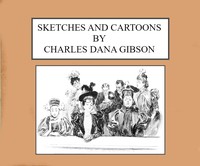
Charles Dana Gibson's Sketches and Cartoons, published in 1900, collects eighty-four drawings that originally appeared in periodicals such as Harper's Weekly and Life. The book is the third in a uniform series, following Drawings by C. D. Gibson and Pictures of People. Gibson's linework is crisp and economical, often relying on a single exaggerated gesture or expression to convey a scene's humor. The captions, frequently dialogue-based, are as essential as the images, delivering punchlines that skewer social pretensions, romantic anxieties, and the rituals of the leisure class.
The Economy of Line and Gesture
Gibson's drawings are notable for their minimal but expressive linework. In One of the Embarrassments, the humor derives entirely from the valet's posture and the protagonist's frozen expression as his valise is unpacked. The artist avoids extraneous detail, focusing on the characters' faces and hands to tell the story. A recurring visual motif is the contrast between the composed, elegant Gibson Girl and the flustered, often foolish men around her. In His Cure, the nightmare of a young man contemplating marriage for money is rendered through a single chaotic scene of grasping hands and dollar signs, the linework growing more frantic to mirror the dream's anxiety.
Dialogue as Social Satire
The captions in Sketches and Cartoons are not mere labels but integral to the comedy. In The Civil Service System, a father treats a suitor's proposal like a bureaucratic application: a clerk consults a book, the suitor is put through a 'usual course of questions,' and placed on an 'eligible list.' The deadpan bureaucratic language mocks the commodification of marriage among the wealthy. Similarly, in A Hint to Fathers, a parent entrusts a late-staying suitor with an important letter that must be mailed before eleven p.m., the caption undercutting the father's supposed vigilance. Gibson's dialogue often reveals the gap between what characters say and what they mean, as in Mutual, where an amateur actor asks to kiss his friend's wife onstage, and the friend replies, 'Not if you don't.'
Recurring Situations and Social Types
Several cartoons revisit the same social scenarios: golf as a backdrop for romantic or competitive tension (Is a Caddie Always Necessary?, One of the Hazards of Golf), the awkwardness of hosting or being hosted (Having Your Host's Valet Unpack Your Valise), and the trials of courtship under parental scrutiny. Gibson populates these scenes with recognizable types: the imperious father, the scheming suitor, the bored heiress. In These Foreign Relations, a man asks, 'Do I want to go in with that crowd?'—the caption alone implying a world of class anxiety. The consistency of these types across the collection suggests Gibson is less interested in individual psychology than in the predictable patterns of social behavior among the American upper class at the turn of the century.
Readers approaching Sketches and Cartoons should pay attention to the interplay between image and text: Gibson's captions often complete or subvert the visual joke. The drawings reward close looking at facial expressions and body language, which carry as much weight as the dialogue. Because the book collects work from various publications, the cartoons are best taken individually rather than as a continuous narrative. The absence of dates or original publication contexts in this edition leaves some references obscure, but the core humor—rooted in social observation—remains accessible.
Reader reflection
What was your reading experience?
Capture what you thought, learned, and would like to remember.
Your progress
0
/
10
2
Did this book hold your interest?
3
Would you recommend this book to another reader?
4
How easy was the book to follow?
5
How closely did the book connect with your experience?
6
How distinctive were its ideas or approach?
7
How understandable was the text?
8
How would you describe its reading pace?
9
In one sentence, what did you learn?
10