1

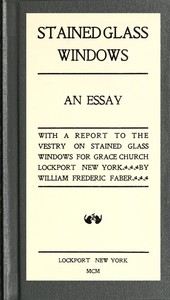
Stained Glass Windows: An Essay: With a Report to the Vestry on Stained Glass Windows for Grace Church Lockport New York — A Reader’s Guide
13
0
Project Gutenberg
2021
Glass painting and staining; Grace Episcopal Church (Lockport, N.Y.)
Readers of public-domain and historical texts
Project Gutenberg digital edition
en
Edition facts
Words: 13,077
Reading time: 57 min
Text sections: 4
Source:
Project Gutenberg record #66766
An essay and parish report by William Frederic Faber, examining stained glass history, technique, and design principles, grounded in the specific case of Grace Church, Lockport, New York.
Editorial Edition Score
4.5/5
★★★★★
★★★★★
Calculated from edition completeness, EPUB availability, text structure and catalogue metadata. Not a user rating.
Edition quality
William Frederic Faber opens his 1900 pamphlet by confronting a tension: the growing fashion for stained glass windows in American churches and the risk that commercial zeal may outpace artistic judgment. Writing as rector of Grace Church, Lockport, he addresses both his own congregation and a wider audience, hoping to foster “a more discriminating appreciation” of church glass. The work combines a historical essay on the development of stained glass from the eleventh century onward with a practical report on the windows installed in his parish between 1897 and 1900. Faber’s voice is measured and occasionally wry—he notes that stained glass is “simply becoming fashionable” and warns against a “vulgar spirit of rivalry” among churches.
A Dual Purpose: Essay and Parish Report
The pamphlet’s structure reflects its twin audiences. The first part is a general essay tracing the evolution of stained glass from Norman round-arched windows through Gothic tracery, drawing on authorities such as Mrs. Van Rensselaer and the designer William Warrington. Faber emphasizes that glass must remain “absolutely subservient” to architecture, a principle he applies to Grace Church’s own Gothic-revival building. The second part, the report to the vestry, documents eleven windows and three mosaics installed under his supervision. Faber notes that the “adopted scheme has been followed, with results more and more obviously satisfactory.” This dual format allows him to move from broad historical principles to specific local decisions, grounding abstract ideas in material choices.
The Language of Materials and Craft
Faber’s prose is precise when describing technical matters. He writes of “plate-traceried” windows, “mullions,” and the “sweep of the great window” that fuses multiple lights into “organic beauty.” His vocabulary reflects a close engagement with the physical making of windows: he discusses the difficulties eleventh-century pioneers faced with “defective materials” and the slow mastery of color and leadwork. At the same time, he is alert to the economic and social pressures on church art. The phrase “epidemic of stained glass” captures his concern that fashion, not devotion, drives many commissions. Faber’s tone shifts between scholarly exposition and pastoral caution, a blend that gives the text its particular character.
Pace and Persuasion in the Report
The report to the vestry moves at a different pace from the historical essay. Where the essay unfolds chronologically, tracing centuries of stylistic change, the report is succinct and practical, listing completed windows and noting that the scheme has been “followed” consistently. Faber’s earlier warning about commercial rivalry gives way to a quieter confidence: the results speak for themselves. The pamphlet’s closing note, dated All Saints’ 1900, reveals that the first edition (1897) was “exhausted” and a second demanded—evidence that Faber’s arguments found an audience. The shift from general anxiety to local accomplishment mirrors the arc of the text itself, from broad critique to specific, realized project.
Readers approaching this work should attend to its dual nature: it is both a historical primer and a case study in ecclesiastical decision-making. Faber’s voice—learned, cautious, occasionally wry—shapes the argument as much as his facts do. The pamphlet rewards those interested in how aesthetic principles are translated into practice, especially within the constraints of a single parish. Faber does not claim to have solved the tensions between art and fashion, but he offers a model of how one congregation attempted to do so with integrity.
Reader reflection
Take a moment to reflect on this book
Create a short personal record of your experience with this book.
Your progress
0
/
10
2
What was your overall reaction to the book?
3
Would you pass this book on to a friend?
4
How easy was the book to follow?
5
How did the reading compare with what you expected?
6
Would you start a conversation about this book?
7
How much did the book move you?
8
How would you rate its originality?
9
What changed or sharpened your thinking?
10