1

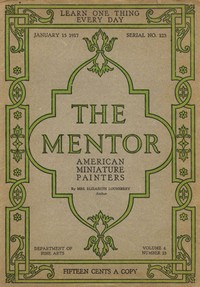
The Mentor: American Miniature Painters, January 15, 1917, Serial No. 123 — Themes and Context
1496
0
Project Gutenberg
2013
Miniature painting -- United States; Portrait painters -- United States; Portrait painting, American -- 19th century
Readers of public-domain and historical texts
Project Gutenberg digital edition
en
Edition facts
Words: 11,223
Reading time: 49 min
Text sections: 2
Source:
Project Gutenberg record #44321
An editorial note on Elizabeth Lounsbery's 1917 monograph on American miniature painters, focusing on the author's descriptive language, narrative shifts between biographical sketches and technical commentary, and the recurring tension between artistic control and spontaneity in the medium.
Editorial Edition Score
4.5/5
★★★★★
★★★★★
Calculated from edition completeness, EPUB availability, text structure and catalogue metadata. Not a user rating.
Edition quality
Elizabeth Lounsbery's account of American miniature painters opens with a philosophical epigraph from William Morris, asserting that art should be 'a language that all can understand.' This framing immediately establishes a tension between the democratic ideals of art and the specialized craft of miniature painting, which Lounsbery later describes as 'not easy of control' and prone to 'labored effects.' The narrative voice moves between biographical sketches of artists like John Trumbull and technical explanations of stippling and ivory surfaces, creating a rhythm that alternates between historical anecdote and practical instruction.
Shifting Registers: From Historical Mission to Technical Precision
Lounsbery's prose shifts noticeably when she moves from Trumbull's patriotic ambitions to the mechanics of miniature painting. Trumbull is quoted as justifying his art by its historical purpose: 'to preserve and diffuse the memory of the noblest series of actions.' This high-minded tone contrasts with the later description of ivory as 'unresponsive to the intention of the hand,' where the language becomes tactile and frustrated. The author uses terms like 'wash up,' 'spotty,' and 'unmanageable' to convey the medium's resistance, a vocabulary absent from the earlier sections. This shift suggests that Lounsbery is not merely cataloging artists but also exploring the gap between artistic intent and material reality.
The Stippling Paradox: Control vs. Spontaneity
A recurring theme in Lounsbery's technical passages is the need for 'repeated light touches' and stippling to achieve form, yet she warns that such methods can lead to 'labored effects' and a loss of 'freshness and directness.' The phrase 'it is art to hide art' is invoked to define the ideal result as 'comfortable, spontaneous and unrestrained.' This paradox—that painstaking control is required to appear effortless—structures her evaluations of artists. William J. Baer is praised for 'unrivalled skill' and 'acknowledged excellence,' while Laura Coombs Hills is commended for 'freshness and brilliancy of rendition' and a 'charmingly natural and unaffected' quality. The criteria are consistent: the best miniatures conceal their own making.
Narrative Pace: Biographical Brevity and Descriptive Detail
The pace of Lounsbery's text varies with each artist. Trumbull receives a relatively extended biographical treatment, including his own words and his role as a 'historical painter.' In contrast, Theodora W. Thayer is dispatched in a few sentences, with Lounsbery noting that her 'short career' produced few works but that her quality rivals Malbone's. The description of Hills's miniature 'Persis' is notably vivid: 'a child with brownish red hair, dressed in faded pink, is seated in relief against the reds and blues of the background.' Such passages slow the reading, inviting visual attention, while the biographical summaries accelerate the narrative. This uneven pacing mirrors the miniature form itself—small, concentrated bursts of detail within a larger framework.
Readers attentive to Lounsbery's language will notice how she uses technical description to imply aesthetic judgment. Her repeated emphasis on 'freshness,' 'directness,' and the concealment of effort offers a lens for evaluating the artists she profiles. The excerpts provide only partial views of each painter's work, but the consistency of Lounsbery's critical vocabulary suggests a coherent set of values. Pay particular attention to how she describes the relationship between the artist's hand and the resistant ivory surface—this tension is the quiet engine of the text.
Reader reflection
Your personal reading reflection
Build a private reading journal entry for this title.
Your progress
0
/
10
2
Was reading this book enjoyable?
3
Would you pass this book on to a friend?
4
What was the reading difficulty like?
5
Did the book offer a fresh perspective?
6
How valuable was this book for your own interests?
7
Did you relate to its people, ideas, or situations?
8
Would a second reading be valuable?
9
What did this book teach you most?
10