1

The Mentor: Makers of American Art, Vol. 1, Num. 45, Serial No. 45 — Inside the Classic
2131
0
Project Gutenberg
2015
Painters -- United States; Painting -- United States
Readers of public-domain and historical texts
Project Gutenberg digital edition
en
Edition facts
Words: 10,282
Reading time: 45 min
Text sections: 7
Source:
Project Gutenberg record #49922
This editorial note examines how the opening, middle, and later excerpts of J. Thomson Willing's 'The Mentor: Makers of American Art' guide a first reading, focusing on the commercial origins of American portraiture, the biographical sketches of artists like Copley and West, and the recurring emphasis on early training and patronage.
Editorial Edition Score
4.6/5
★★★★★
★★★★★
Calculated from edition completeness, EPUB availability, text structure and catalogue metadata. Not a user rating.
Edition quality
The opening of J. Thomson Willing's 'The Mentor: Makers of American Art' immediately establishes a commercial framework for early American painting, stating that art 'conformed to the law of demand and supply.' The text notes that in 'prephotographic days,' portraits served as records for a rising colonial class, and that the 'Colonial period was barren of good production.' This blunt assessment sets a pragmatic tone, emphasizing economic drivers over aesthetic ideals. The reader is thus primed to view the subsequent artist biographies not as isolated genius stories but as responses to market conditions.
Commercial Roots and Artistic Emergence
The opening paragraphs foreground the portrait market as the engine of early American art. Willing writes that after the Revolution, 'the portrait market was good,' and that the 'commercial artist was there to take orders and deliver the goods.' This framing is reinforced by the mention of specific commissions: family portraits for the prosperous, then portraits of 'political heroes,' and later historical pictures. The text explicitly states that 'the genre picture did not come until about the middle of the nineteenth century,' confining the scope to portraiture and history painting. For a first-time reader, this economic lens explains why the book focuses on painters like Copley, West, and Peale—all of whom built careers on commissioned portraits. The excerpts do not reveal whether later sections broaden into landscape or still life, but the opening strongly suggests a sustained interest in the business of art.
Biographical Structure and the Role of Patronage
The middle excerpts shift to individual biographies, each following a similar pattern: early talent, limited training, European study, and eventual success. Benjamin West's story, for instance, begins with a boy whose 'reading was limited to the Bible' until an artist lent him books on painting. The narrative then traces his path from Philadelphia to Italy to London, where he 'succeeded Reynolds as president of the Royal Academy.' Charles Willson Peale's biography mirrors this arc: apprenticed to a saddler at thirteen, he began art at twenty-three, studied under Copley and West, and later painted the 'earliest known portrait' of Washington. The repeated emphasis on European training and royal or institutional patronage suggests that the book values international validation. A reader should note how each biography highlights a pivotal mentor or patron, reinforcing the 'Makers' theme of the series title.
Recurring Details: Early Training and First Commissions
Across the excerpts, specific details recur that anchor the narratives in concrete moments. For West, the text mentions his first money from art and a 'solemn scene in the sober Quaker home' where he was dedicated to art. For Peale, it notes his first teacher was 'a Swedish painter, Hessellius,' and that he painted a three-quarter-length Washington in 'the uniform of a Virginian military colonel.' These details—the first sale, the first teacher, the first notable commission—serve as touchstones for the reader, making the artists' progress tangible. The text also repeatedly names specific institutions and locations: the Boston Museum of Fine Arts, the Pennsylvania Academy, Independence Hall. This geographical specificity grounds the narrative in actual places, inviting the reader to connect the artworks mentioned (like 'Christ Healing the Sick' or 'Lady Wentworth') with their current homes. The excerpts do not provide full descriptions of these works, but the references create a sense of a living archive.
Voice and Authorial Stance
Willing's voice is direct and evaluative, often making judgments about quality. He calls early colonial art 'far from fine' and describes West's 'Death on the Pale Horse' as 'melodramatic in character.' This critical tone is consistent: he praises Copley and West as 'wonderfully good workers' while dismissing their contemporaries. The author also uses colloquial phrases like 'the goods he delivered were of a very high grade of workmanship,' blending commercial language with art criticism. For a first-time reader, this voice signals that the book is not a neutral survey but an opinionated guide. The excerpts do not reveal whether later sections maintain this tone, but the opening and middle passages establish a clear authorial personality—one that values technical skill, market success, and European training. Readers should be alert to this perspective, as it shapes which artists are celebrated and which are omitted.
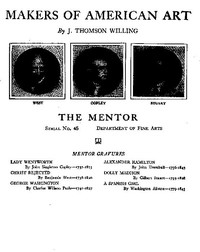
As you read, pay attention to how Willing balances individual achievement with broader historical forces. The excerpts suggest that each artist's story is framed by the demands of patronage and the limits of colonial culture. Notice also the recurring motif of the 'first'—first portrait, first teacher, first commission—which structures the biographies as a series of breakthroughs. The book's brevity (about 45 minutes of reading) means each sketch is concise; the editorial note encourages you to consider what is left out, such as the artists' personal lives or later critical reception. Use the Mentor gravures listed at the start as visual anchors for the text.
Reader reflection
Record your reading impressions
A brief reflection can help important ideas stay with you longer.
Your progress
0
/
10
2
Did this book hold your interest?
3
Would you pass this book on to a friend?
4
How demanding did the text feel?
5
Did anything about the book feel genuinely new?
6
Could you see yourself revisiting this book?
7
Could you follow the author’s main argument?
8
Did the story or argument move comfortably?
9
In one sentence, what did you learn?
10