1

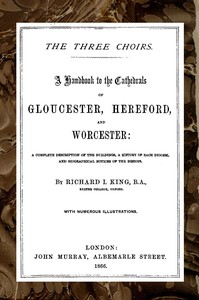
The Three Choirs: A Handbook to the Cathedrals of Gloucester, Hereford, and Worcester A Complete Description of the Buildings, a History of Each Diocese and — Story, Setting & Ideas
474
0
Project Gutenberg
2021
Gloucester Cathedral; Church architecture -- England; Cathedrals -- England; Hereford Cathedral; Worcester Cathedral
Readers of public-domain and historical texts
Project Gutenberg digital edition
en
Edition facts
Words: 59,521
Reading time: 259 min
Text sections: 9
Source:
Project Gutenberg record #65390
This editorial note examines R. J. King's 1866 handbook on Gloucester, Hereford, and Worcester cathedrals, focusing on the tension between architectural description and ecclesiastical biography, the recurring motif of ruin and restoration, and the author's reliance on medieval chroniclers.
Editorial Edition Score
4.7/5
★★★★★
★★★★★
Calculated from edition completeness, EPUB availability, text structure and catalogue metadata. Not a user rating.
Edition quality
R. J. King’s The Three Choirs (1866) presents a structural paradox: it is a handbook for travellers yet devotes substantial space to episcopal biographies and diocesan history. The work is divided into three self-contained sections, each covering one cathedral, with detailed architectural descriptions, lists of bishops, and illustrations. King’s method oscillates between precise architectural observation—such as the “Prentice’s Bracket” in Gloucester—and narrative accounts of medieval bishops, often drawn from chroniclers like the compiler of Bishop Cantilupe’s “Life and Gests.” This dual focus creates a distinctive tension between the static fabric of the buildings and the turbulent lives of their prelates.
Architecture and the Weight of History
King’s architectural descriptions are meticulous but frequently interrupted by historical digressions. In the Gloucester section, he traces the Norman church, the nave vaulting, and the “Whispering Gallery” with technical precision, yet the text is punctuated by accounts of parliaments held in the abbey and lists of abbots. The Hereford and Worcester sections follow a similar pattern: architectural details are interwoven with notices of bishops, many of whom met violent ends or engaged in legal disputes. King’s method suggests that the buildings cannot be understood apart from the human conflicts that shaped them. For instance, the description of Bishop Cantilupe’s tomb in Hereford is preceded by a lengthy account of his excommunication and death near Orvieto. The architecture becomes a repository of memory, but King does not always reconcile the two strands.
Bishops, Conflict, and the Limits of Biography
King’s biographical notices are often drawn from medieval sources, but he does not always verify their claims. The account of Bishop Cantilupe includes the story that his bones “bled afresh” when touched by the Earl of Gloucester—a detail King reports without comment. Similarly, the description of Bishop Peter of Aquablanca notes that he left “no good reputation,” yet King records his charitable bequests. These tensions reveal the handbook’s reliance on chroniclers who were themselves partisan. King’s own voice is restrained; he rarely offers judgment, preferring to let the sources speak. This approach gives the biographies a fragmentary quality, as if the reader is encountering raw material rather than synthesized history. The result is a work that is more a compendium than a coherent narrative.
Ruin, Restoration, and the Victorian Present
A recurring motif in King’s text is the state of ruin and subsequent restoration. He notes that the church and ecclesiastical establishment were “in a state of ruin and decay” at certain points, and his descriptions often highlight repairs and rebuildings. The Norman church, the cloisters, and the chapter-house are all discussed in terms of their preservation or alteration. King’s own era—the mid-Victorian period—was one of active restoration, and his handbook implicitly participates in that project by cataloguing what remained. Yet he does not explicitly advocate for restoration; instead, he presents the buildings as palimpsests, with layers of Norman, Gothic, and later additions. The reader is left to infer that the cathedrals are living structures, continually reshaped by history.
King’s handbook is best approached as a Victorian curiosity—a work that straddles the genres of travel guide, architectural treatise, and ecclesiastical history. Readers interested in the physical fabric of the cathedrals will find detailed descriptions, but they must navigate the biographical interludes. Those drawn to medieval church history will encounter vivid, if uncritical, accounts of bishops and their conflicts. The work rewards patience and a willingness to follow King’s digressions, which often reveal more about the author’s sources than about the buildings themselves.
Reader reflection
Take a moment to reflect on this book
Create a short personal record of your experience with this book.
Your progress
0
/
10
2
How did the book work for you overall?
3
Is this a title you would suggest to others?
4
What was the reading difficulty like?
5
What did you appreciate most?
6
Would you read this book again?
7
Would you start a conversation about this book?
8
Did any part of the book feel personally relevant?
9
In one sentence, what did you learn?
10