1

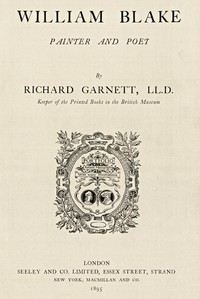
William Blake, Painter and Poet — Context and Discussion
(0 User reviews)
1465
Project Gutenberg
2016
Not confirmed
Poets, English -- 19th century -- Biography; Poets, English -- 18th century -- Biography; Blake, William, 1757-1827; Artists -- Great Britain -- Biography
Readers of public-domain and historical texts
Project Gutenberg digital edition
en
Edition facts
Words
27,225
Reading time
119 min
Text sections
5
For William Blake, Painter and Poet — Context and Discussion, the stored edition analysis reports 27,225 words, 1 hr 59 min estimated reading time, and 5 detected text sections.
The text analysis averages about 25.1 words per sentence, while the detected sections provide another way to judge how the source is divided.
Project Gutenberg metadata also associates the work with “Poets, English -- 19th century -- Biography,” connecting these edition facts with the source record’s subject description.
Source:
Project Gutenberg record #52300
Richard Garnett's 1895 study of William Blake examines the interplay between his poetry and visual art, drawing on contemporary criticism and excerpts from works like Jerusalem and Milton to illuminate Blake's dual legacy as painter and poet.
Read the complete public-domain text at its original source.
Read on Project GutenbergRichard Garnett opens his 1895 study by positioning William Blake as an exceptional figure among artists, noting that only Dante Rossetti rivals Blake in having his fame as a poet match his fame as a painter. Garnett, then Keeper of Printed Books at the British Museum, draws on his scholarly vantage to assess Blake's dual legacy. The book's structure moves from biographical chapters to critical analysis of Blake's major works, including Songs of Innocence and of Experience, The Book of Thel, America, Milton, and Jerusalem. Garnett frequently cites contemporary critics like Gilchrist and Swinburne, and includes numerous illustrations from Blake's engravings and watercolours.
Garnett's Critical Method
Garnett's approach is evaluative and comparative. He judges Blake's blank verse as monotonous, claiming that Blake's "originally exquisite perception of harmony had waned with his lyrical faculty." Yet he praises the "general grandiose effect" of Jerusalem, comparing it to "the booming of the billows, or the whisper of the winds in the wood." This tension between critique and admiration runs throughout the book. Garnett also relies heavily on Alexander Gilchrist's earlier biography, warning that Jerusalem cannot be judged without seeing Lord Crewe's "incomparable" copy. The excerpts show Garnett weaving together his own observations with those of other scholars, creating a layered commentary.
Poetry as Pictorial Imagination
A central argument in Garnett's analysis is that Blake's poetry depends on his pictorial imagination. He illustrates this with a passage from Jerusalem describing a woman who "creates at her will a little moving night and silence, / With spaces of sweet gardens and a tent of elegant beauty." Garnett calls this a "magnificent expansion" of a glowworm idyll, linking it to Beddoes' phrase "with her little drop of moonlight." He contends that Blake's verse often reads as a verbal translation of visual scenes. The excerpts also include a description of designs from Milton and Jerusalem, where "female figures lie among waves full of reflected stars" and "serpent-women are coiled with serpents," reinforcing the fusion of word and image.
The Felpham Influence on Later Works
Garnett asserts that Milton and Jerusalem, both dated 1804, must have been composed at Felpham, where Blake lived from 1800 to 1803. He argues that "nothing save actual and present contact with country scenes could have inspired" the passage in Milton where the lark "springing from the wavy corn-field loud / He leads the choir of day: trill, trill, trill, trill." This attention to biographical context is typical of Garnett's method: he uses external evidence to ground his interpretations. The excerpts do not reveal whether Garnett provides further proof of this claim, but the connection between place and poetic detail is a recurring thread in his analysis.
Blake's Mythic and Symbolic Vocabulary
Garnett describes Blake's later works as "a gigantic arabesque, imbued with a passion and pathos not elsewhere attempted in this branch of art." He notes the presence of "Assyrian-looking, human-visaged bulls" and "eagle-headed creatures" in the designs, and explains that the subject of Milton is, in Swinburne's words, "the incarnation and descent into earth and hell of Milton, who represents redemption by inspiration." Garnett draws a parallel to the oldest Assyrian poetry, suggesting a universal theme of pilgrimage through a lower sphere. The excerpts show that Garnett is more comfortable describing visual elements than explicating Blake's complex mythology, often deferring to other critics for interpretation.
Garnett's study offers a late-Victorian perspective on Blake, balancing admiration with critical distance. Readers should note that the excerpts are drawn from the opening and middle sections, focusing on Blake's major works and Garnett's method. The later chapters, not excerpted here, likely cover Blake's final years and posthumous reputation. As a first reading, pay attention to how Garnett uses quotations from Blake's poetry and from contemporary critics to build his arguments, and consider how his own position as a librarian and scholar shapes his judgments.
Reading about Blake’s drive to fuse word and image, I remembered standing in a dusty Turin library, tracing engravings in Letters of an Architect, From France, Italy, and Greece. Volume 2 [of 2] — Story, Setting & Ideas. That book, too, felt like someone trying to make stone speak—each letter a quiet hand pressing light into shadow, much as Blake’s plates held their own stubborn glow.
There are no reviews for this eBook.
There are no comments for this eBook.
Reader reflection
Before you leave, reflect on the book
Use these questions to collect your thoughts before moving on.
Your progress
0
/
10
2
Was reading this book enjoyable?
3
Would you recommend this book to another reader?
4
Did the language feel accessible?
5
How understandable was the text?
6
Which aspect of the book did you value most?
7
Did you relate to its people, ideas, or situations?
8
Did anything about the book feel genuinely new?
9
In one sentence, what did you learn?
10