1

A short history of architecture — A Closer Reading
(0 User reviews)
802
Project Gutenberg
2025
Not confirmed
Architecture -- History
Readers of public-domain and historical texts
Project Gutenberg digital edition
en
Edition facts
Words
41,510
Reading time
181 min
Text sections
19
Before opening A short history of architecture — A Closer Reading, the edition data offers a quick orientation: 41,510 words, 3 hr 1 min estimated reading time, and 19 detected text sections.
The text analysis averages about 26.3 words per sentence, while the detected sections provide another way to judge how the source is divided.
Project Gutenberg metadata also associates the work with “Architecture -- History,” connecting these edition facts with the source record’s subject description.
Source:
Project Gutenberg record #76489
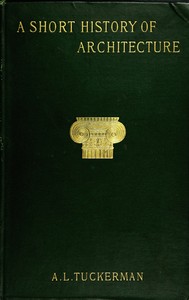
Arthur Lyman Tuckerman's 1887 survey traces architectural styles from origin to successor, emphasizing structural evolution over technical jargon. The preface frames the work as a concise alternative to connoisseur-focused treatises, aiming to equip general readers and school students with historical facts rather than gushing descriptions.
Read the complete public-domain text at its original source.
Read on Project GutenbergArthur Lyman Tuckerman opens his 1887 survey with a quotation from Longfellow's Michael Angelo that declares architecture "the noblest art of all the arts," existing in itself rather than as a shadow of outward things. This epigraph sets a tone of advocacy for the built form as substance over representation. In the preface, Tuckerman explicitly addresses readers who want "the main facts without having to read voluminous works" aimed at connoisseurs. He promises to trace each style's origin, characteristic points, and connection to predecessors and successors, while avoiding technical terms and most dates. The author also expresses a wish that schoolboys learn as much about architectural history as about warfare, positioning the book as a corrective to conventional education.
A Preface That Argues for Architectural Literacy
Tuckerman's preface is a compact manifesto. He writes that he has "written this short history of architecture to meet the requirements of those who wish to become acquainted with the main facts" without wading through critical or theoretical essays. The plan is to trace each style's origin, characteristic points, and connection to what preceded and succeeded it. He deliberately avoids "technical terms or any but the most important dates." The author acknowledges a temptation to enter into social and political histories of each building race, but says brevity forbids this, as well as "any of the gushing descriptions usually found in modern handbooks on art." He hopes the volume may interest the general reader and find its way to schools beyond art specialties, arguing that learning about "the most useful and beautiful of the creations of the people of each age" is as valuable as studying warfare.
The Basilica as a Case Study in Descriptive Method
In the excerpt on early Christian basilicas, Tuckerman's descriptive method is on full display. He details the typical arrangement: an atrium or narthex, a nave derived from "navis" (a vessel, symbolical of that of St. Peter), side aisles, transept, and apse. He notes that columns were often taken from older buildings, and if new, were of stouter proportions than Classical models. The description of the baldachin over the altar includes the detail that malachite and other choice stones were "used unsparingly." Tuckerman also records that the walls of the transept and apse were inlaid with mosaic inscriptions and pictures, with deep blue, purple, and green as prevailing colors and letters of gold. He observes that externally there was no attempt at enrichment, offering a great contrast to lavish internal decorations. The passage concludes with a list of surviving examples, including St. Maria Maggiore and San Clemente in Rome, and San Appolinare in Ravenna.
Diction That Balances Precision and Accessibility
Tuckerman's word choices reveal a deliberate effort to be clear without oversimplifying. He uses terms like "atrium," "narthex," "transept," and "apse" but explains them in context. The phrase "the triumphal arch" is introduced as a wide arched opening connecting the nave to the transept. He describes the roof as either flat with sunken panels framed with mouldings and gilded ornaments, or showing open trussed wood-work, noting the latter was the exception. When discussing later transformations, he writes that basilicas have been "disfigured by the heterogeneous decoration of the eighteenth century." This language is evaluative but grounded in observable change. The author's voice is that of a knowledgeable guide who trusts the reader to follow a reasoned argument, not a breathless enthusiast.
Structure and the Avoidance of Technical Overload
The book's structure, as outlined in the preface, is chronological and comparative: each style is introduced with its origin, characteristic points, and connection to preceding and succeeding styles. Tuckerman explicitly limits the use of dates and technical terms. In the basilica excerpt, he mentions dimensions ("about 380 feet long by 212 feet in width") and the order of columns (Ionic or Corinthian), but does not dwell on proportional systems or obscure vocabulary. He also notes that the clerestory was derived later on from the range of windows at the top of the nave wall. This forward-looking remark is typical of his method: he connects features to later developments without losing focus on the immediate subject. The result is a narrative that moves efficiently from one period to the next, fulfilling the promise of a "short history."
Tuckerman's A Short History of Architecture is best approached as a deliberately concise primer, written by an author who valued substance over ornament. Readers should expect clear descriptions of building types and stylistic transitions, with minimal technical jargon. The preface's wish that schoolchildren learn as much about architecture as about warfare signals the book's educational ambition. Those seeking a quick, structured overview of Western architectural history will find Tuckerman a reliable, if occasionally opinionated, guide.
That old Tuckerman book stayed with me because it let buildings breathe—no shouting about beauty, just the quiet march of stone and arch through time. It reminded me of leafing through Illuminated illustrations of Froissart; Selected from the ms. in the Bibliothèque royale, Paris, and from other sources — Key Ideas to Explore, where history feels less like a lesson and more like a hand resting on your shoulder. Both whispered, somehow.
There are no reviews for this eBook.
There are no comments for this eBook.
Reader reflection
What was your reading experience?
Capture what you thought, learned, and would like to remember.
Your progress
0
/
10
2
Was reading this book enjoyable?
3
Is this a title you would suggest to others?
4
How much effort did this book require?
5
How would you rate its originality?
6
How strong was your personal connection to the text?
7
Is this a title worth rereading?
8
Did the book deliver what you hoped for?
9
Which lesson or insight stayed with you?
10