1

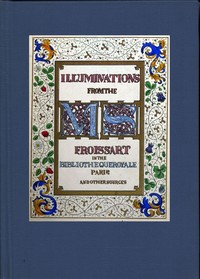
Illuminated illustrations of Froissart; Selected from the ms. in the Bibliothèque royale, Paris, and from other sources — Key Ideas to Explore
(0 User reviews)
211
Project Gutenberg
2021
Not confirmed
Illumination of books and manuscripts -- Specimens; Froissart, Jean, 1338?-1410? Chroniques -- Illustrations
Readers of public-domain and historical texts
Project Gutenberg digital edition
en
Edition facts
Words
11,095
Reading time
49 min
Text sections
3
This digital edition of Illuminated illustrations of Froissart; Selected from the ms. in the Bibliothèque royale, Paris, and from other sources — Key Ideas to Explore is described by source-level measurements including 11,095 words, 49 min estimated reading time, and 3 detected text sections.
The text analysis averages about 23.7 words per sentence, while the detected sections provide another way to judge how the source is divided.
Project Gutenberg metadata also associates the work with “Illumination of books and manuscripts -- Specimens,” connecting these edition facts with the source record’s subject description.
Source:
Project Gutenberg record #64454
H. N. Humphreys' 1845 volume reproduces 36 illuminated plates from Froissart's Chronicles, pairing each with a historical note. The catalog subjects list 'Illumination of books and manuscripts -- Specimens' and 'Froissart, Jean, 1338?-1410? Chroniques -- Illustrations,' but the excerpts reveal a work that is as much about 19th-century antiquarian commentary as about medieval art.
Read the complete public-domain text at its original source.
Read on Project GutenbergH. N. Humphreys' Illuminated Illustrations of Froissart (1845) reproduces thirty-six plates from a manuscript then in the Bibliothèque royale, Paris, and other sources, each accompanied by a descriptive note. The catalog subjects—'Illumination of books and manuscripts -- Specimens' and 'Froissart, Jean, 1338?-1410? Chroniques -- Illustrations'—suggest a straightforward facsimile or art-historical record. Yet the excerpts show that Humphreys' text does more than caption images: it narrates the historical episodes depicted, often with moralizing asides and editorial commentary, making the volume a hybrid of picture-book and condensed chronicle.
The Plates as Historical Narrative, Not Mere Specimens
The catalog subject 'Illumination of books and manuscripts -- Specimens' implies a focus on artistic technique or manuscript production. But Humphreys uses each plate as a springboard to recount the event it illustrates. For example, Plate XXII, 'Beheading of Silvester Budes,' is described with a full paragraph on Budes' capture, escape, and execution 'at the instigation of the Cardinal of Amiens.' The illumination is said to show 'the headsman performing his office with a two-handed sword, in the presence of the Pope and Cardinal.' This is not a specimen description—it is a miniature history lesson. Similarly, Plate XXI, 'The Funeral of Jehan de Lyon,' includes details about the 'White-hoods' association and the suspicion of poisoning. The images serve as prompts for storytelling, not as objects of formal analysis.
Humphreys' Voice: Moral Inference and Editorializing
Humphreys does not merely transcribe Froissart; he adds his own judgments. Of the arrest of Sir Bernabo Visconti (Plate XX), he writes that 'the cotemporary opinion respecting events of this description may be inferred from the circumstance that Galeas Visconti, becoming thus duke of Milan, was enabled to marry his daughter to the then most powerful prince in Europe.' This is a pointed comment on political cynicism, not a neutral summary. Elsewhere, he speculates on causes—Jehan de Lyon's 'subsequent disgrace, he makes one of the principal causes' of the Ghent revolt—and notes that 'from the swelling of his body and other symptoms, it is supposed he was poisoned.' These inferences go beyond the illuminations themselves, revealing Humphreys as an active interpreter of Froissart's text.
The Material Book: Borders, Compression, and the 'Exact Copy'
Humphreys occasionally remarks on the physical adaptation of the manuscript images. In Plate XXIII, 'The Duke of Burgundy Entering Chartres,' he notes that 'the background, and some unimportant features, have been slightly compressed, to accommodate the subject to the size of our work; in other respects, the Plate is an exact copy of the original.' This admission of alteration—while claiming fidelity—highlights the tension between reproduction and interpretation. The plate is described as 'surrounded by a rich border,' forming 'the frontispiece to a manuscript of the Chronicles of Froissart, which are unfortunately incomplete.' Such details remind the reader that the volume is a 19th-century selection, not a neutral window onto a medieval artifact.
Readers should approach this volume as a 19th-century antiquarian's curated edition, not as a facsimile or art catalogue. Humphreys' commentary, while informative, reflects Victorian tastes for moral narrative and historical anecdote. To understand the illuminations themselves, one would need to consult the original manuscripts or modern art-historical studies. This edition is best used as a companion to Froissart's text, with an awareness that the images and notes are filtered through Humphreys' editorial lens.
I’ve often lingered over the Illuminated Froissart, its gold leaf still warm after centuries. And there’s a quiet kinship with Mediæval Military Architecture in England, Volume 2 (of 2) — Text and Context — both trust the stone, the ink, to hold what men hoped would last. They sit well together, those two.
There are no reviews for this eBook.
There are no comments for this eBook.
Reader reflection
Before you leave, reflect on the book
Use these questions to collect your thoughts before moving on.
Your progress
0
/
10
2
How much did you enjoy the reading experience?
3
Would you recommend this book to another reader?
4
How much effort did this book require?
5
How strong was your personal connection to the text?
6
How useful were the ideas in this book?
7
Could you follow the author’s main argument?
8
Was the book what you thought it would be?
9
Which lesson or insight stayed with you?
10