1

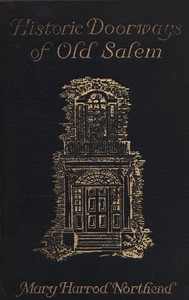
Historic doorways of Old Salem — Text and Context
(0 User reviews)
3850
Project Gutenberg
2022
Not confirmed
Architecture, Colonial; Doorways; Architecture -- Massachusetts -- Salem; Salem (Mass.) -- Buildings, structures, etc.
Readers of public-domain and historical texts
Project Gutenberg digital edition
en
Edition facts
Words
23,056
Reading time
101 min
Text sections
12
Before opening Historic doorways of Old Salem — Text and Context, the edition data offers a quick orientation: 23,056 words, 1 hr 41 min estimated reading time, and 12 detected text sections.
The text analysis averages about 27.0 words per sentence, while the detected sections provide another way to judge how the source is divided.
Project Gutenberg metadata also associates the work with “Architecture, Colonial,” connecting these edition facts with the source record’s subject description.
Source:
Project Gutenberg record #68614
Examines Salem's historic doorways through precise architectural description, focusing on the work of ship carpenters and Samuel McIntire, with attention to hand-tooled ornamentation, fanlights, and the interplay of Georgian and Colonial styles.
Read the complete public-domain text at its original source.
Read on Project GutenbergMary Harrod Northend's Historic Doorways of Old Salem opens with a striking claim: Salem's doorways were the work of ship carpenters or figurehead carvers, with the finest designed by Samuel McIntire. This origin in maritime craftsmanship gives the doorways a distinctive character, blending Doric and Corinthian elements with hand-tooled ornamentation. Northend's descriptions are precise, noting details like 'spider-web fanlights,' 'elliptical roofs,' and 'fluted Tuscan pilasters.' She traces the evolution from Derby Street to Chestnut Street, linking architectural choices to the city's mercantile history. The foreword establishes a romantic tone, calling the doorways 'romantic memories of a glorious past,' but the body text remains firmly grounded in observable features.
Craftsmanship and Materials
Northend consistently highlights the hand-tooled nature of Salem's doorways. She describes 'hand-tooled ornamentation' on pediments and 'hand-tooled wooden wreaths' that adorn triangular designs. The materials are equally specific: marble sills, keyed lintels, and cast-iron fences with 'square openwork posts resembling tree-boxes.' The author notes that the most beautiful doorways were designed by Samuel McIntire, a wood-carver who combined various architectural types and adapted them to the Georgian style. This emphasis on manual skill sets the doorways apart from later reproductions, which Northend implies lack the same quality. She observes that modern architects copy these historic designs because they 'have never been excelled by modern-day work.' The reader gains a clear sense of the physical labor and artistry involved in creating these entrances.
The Role of Ship Carpenters
A recurring theme is the connection between Salem's maritime industry and its architecture. Northend states that the doorways were 'the work of ship carpenters or men who carved figureheads.' This link explains the structural precision and decorative flair seen in the doorways. The same skills used to build ships—joinery, carving, proportion—were applied to houses. The author traces this influence through specific examples: the Cook-Oliver house on Federal Street features 'rare bits of hand-tooling' taken from the Elias Hasket Derby mansion, which was considered the finest house of its day. By grounding the doorways in Salem's shipbuilding heritage, Northend provides a practical explanation for their unique aesthetic. The reader understands that these doorways are not just ornamental but functional artifacts of a working port city.
Architectural Evolution and Style
Northend documents the evolution of Salem doorways from simple gambrel-roofed houses to more elaborate Georgian designs. She notes that later houses were 'square or rectangular' with 'foreshortened' third-story windows to make the building appear lower. The doorways themselves evolved from plain entrances to those with 'pilasters with Doric or Corinthian feeling' and 'triangular pediments.' The author pays close attention to fanlights, describing a 'spider-web fanlight of beautiful proportions' that surmounts a doorway flanked by side-lights. She also mentions the use of 'quoined corner-boards, an ornamental cornice, a balustraded roof, or decorative lintels' to relieve the severity of the façade. This systematic cataloging allows the reader to trace stylistic changes across Salem's streets, from the early Rebecca Nurse House to the later J. Foster Smith House.
Notable Houses and Their Doorways
Northend devotes sections to individual houses, each with a distinct doorway. The Rebecca Nurse House, the John Ward House, and the Tucker-Rice House are among those described. The House of the Seven Gables receives special attention: Northend notes its date (1662, from an iron fire-back) and its association with Nathaniel Hawthorne, who was confirmed in the choice of the novel's title by a remark from Susan Ingersoll. The J. Foster Smith House features a 'typical enclosed porch' with oval side-lights and a triangular pediment adorned with a hand-tooled wooden wreath, often decked with Christmas greens. The Grace Machado House is noted for its 'gorgeous wistaria' covering the entire front. These examples show how Northend blends architectural detail with local history, grounding each doorway in the lives of Salem's families.
Northend's work is best read as a field guide to Salem's architectural heritage, with attention to the specific vocabulary of doorway design. Readers interested in the craft of woodcarving or the history of American Colonial architecture will find precise observations about fanlights, pilasters, and pediments. The book assumes familiarity with architectural terms, but the descriptions are clear enough for a motivated amateur. For those planning a visit to Salem, the text offers a systematic way to appreciate the doorways as both art and history.
There’s a particular hush in studying Salem’s carved doorways—the patient, hand-tooled fanlights feel like quiet greetings from another century. That same stillness surfaced while paging through the British Museum’s sculpture catalogue, where marble figures hold their own long silences across ages. Sometimes the oldest thresholds, whether wood or stone, simply wait for someone to notice their gentleness. A Catalogue of Sculpture in the Department of Greek and Roman Antiquities, British Museum, Volume 1 (of 2) — Background and Themes felt like another doorway altogether, open to the same kind of unhurried wonder.
There are no reviews for this eBook.
There are no comments for this eBook.
Reader reflection
What was your reading experience?
Capture what you thought, learned, and would like to remember.
Your progress
0
/
10
2
How much did you enjoy the reading experience?
3
Would you pass this book on to a friend?
4
Did the language feel accessible?
5
How well did it match your expectations?
6
Did the book offer a fresh perspective?
7
Would you like to discuss this book with someone?
8
Was the book moving at the right speed?
9
What did this book teach you most?
10