1

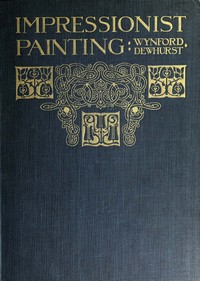
Impressionist painting: its genesis and development — Background and Themes
(0 User reviews)
167
Project Gutenberg
2022
Not confirmed
Impressionism (Art); Artists -- Portraits
Readers of public-domain and historical texts
Project Gutenberg digital edition
en
Edition facts
Words
50,901
Reading time
222 min
Text sections
22
Before opening Impressionist painting: its genesis and development — Background and Themes, the edition data offers a quick orientation: 50,901 words, 3 hr 42 min estimated reading time, and 22 detected text sections.
The text analysis averages about 20.3 words per sentence, while the detected sections provide another way to judge how the source is divided.
Project Gutenberg metadata also associates the work with “Impressionism (Art),” connecting these edition facts with the source record’s subject description.
Source:
Project Gutenberg record #69533
Wynford Dewhurst's 1904 study traces Impressionism's origins and development, combining personal artistic testimony with documented accounts of painters like Monet and Maufra, emphasizing the movement's technical and philosophical evolution.
Read the complete public-domain text at its original source.
Read on Project GutenbergWynford Dewhurst opens his 1904 study with a personal account of his own conversion to Impressionism, describing how he was charged with copying Monet's style before ever seeing the master's work. This autobiographical framing establishes the author as both advocate and practitioner, a painter who turned to writing out of a perceived need for propaganda on behalf of a movement he felt was neglected in England. The preface reveals a collector's instinct: Dewhurst had amassed documents on Impressionism for years, and these formed the basis for magazine articles that now appear in revised form. The book's dedication to Claude Monet signals its allegiances, while the inclusion of artists like Maxime Maufra—whose career is traced from commercial failure to Durand-Ruel's patronage—shows a focus on individual trajectories within the broader school.
A Painter's Manifesto in Prose
Dewhurst writes from the dual position of practitioner and propagandist. His preface recounts a student epiphany in Paris in 1891, when he encountered Impressionist painting directly for the first time. The language is that of conversion: 'my conversion into an enthusiastic Impressionist was short, in fact, an instantaneous process.' This personal testimony gives the book a persuasive urgency. Dewhurst does not feign scholarly detachment; he admits feeling 'none too well equipped' for writing, yet presses forward because 'a stimulating propaganda being needed.' The result is a text that blends art-historical argument with the fervor of a believer. Readers should note how the author's own artistic commitments shape his selection of evidence and his judgments about which painters exemplify true Impressionist principles.
The Maufra Case Study: Biography as Argument
The extended account of Maxime Maufra's career functions as a miniature exemplar of Impressionist struggle and success. Dewhurst details Maufra's reluctant commercial training in Liverpool, his escape from business after a lucky deal, and years of obscurity before Durand-Ruel's intervention. The narrative is built from concrete details: copying in museums, sketching docks at New Brighton, a one-man show in Paris. Quotations from critics Octave Mirbeau and Arsène Alexandre are woven in to validate Maufra's achievement. Alexandre's formulation—that Maufra's 'point de départ is a quick and profound impression' while his 'realisation is a calculated and skilful art'—is offered as a definition of 'complete Impressionism.' This biographical approach allows Dewhurst to argue that Impressionism is not merely a technique but a career path requiring resilience and the right patron.
Rhythmic Line and the Next Generation
Near the end of the excerpt, Dewhurst notes a shift among younger painters: 'The ethereal tints in nature which the pioneers were happy to reproduce, does not satisfy the younger men now that the fundamental laws of the Impressionists have been agreed upon.' This observation signals a historical consciousness within the book—an awareness that Impressionism itself is evolving. The phrase 'attracted by beautiful rhythmic line, balance of form, by composition as well as by colour' suggests that later practitioners are synthesizing Impressionist color with more structured composition. Dewhurst's own prose mirrors this shift: after the dense biographical narrative of Maufra, he steps back to generalize about generational change. The book thus moves between close study of individual artists and broader claims about the movement's trajectory, a rhythm that rewards attentive reading.
Dewhurst's book is best approached as a primary document of early twentieth-century art advocacy rather than a neutral history. Readers interested in the rhetoric of artistic movements will find rich material in how the author constructs a lineage, selects exemplars, and positions himself within the story. The text's value lies not only in its information about Impressionist painters but in its demonstration of how a practitioner-writer shaped the movement's public image in England. Pay attention to the interplay between personal anecdote and critical quotation—this is where Dewhurst's persuasive strategy is most visible.
That rainy afternoon, Impressionist Painting kept me company, its pages tracing Monet’s patient light through a soft, grey window. I paused on a passage about atmosphere, feeling oddly anchored by the weight of old stones. Later, gathering my coat, I noticed a dust-jacket for Historic doorways of Old Salem — Text and Context, and the two books seemed to whisper to each other about quiet thresholds.
There are no reviews for this eBook.
There are no comments for this eBook.
Reader reflection
Record your reading impressions
A brief reflection can help important ideas stay with you longer.
Your progress
0
/
10
2
How much did you enjoy the reading experience?
3
How likely are you to recommend this book?
4
How easy was the book to follow?
5
Did the book deliver what you hoped for?
6
What did you think about the pace?
7
Did it raise ideas you would like to talk about?
8
Would you read this book again?
9
Which lesson or insight stayed with you?
10