1

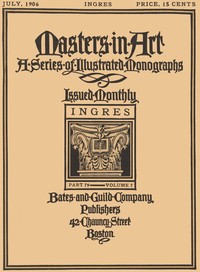
Masters in Art, Part 79, Volume 7, July, 1906: Ingres A Series of Illustrated Monographs — Themes and Context
(0 User reviews)
418
Project Gutenberg
2014
Not confirmed
Painters -- France -- Biography; Ingres, Jean-Auguste-Dominique, 1780-1867; Portrait painting, French -- 19th century
Readers of public-domain and historical texts
Project Gutenberg digital edition
en
Edition facts
Words
17,459
Reading time
76 min
Text sections
3
The catalog record for Masters in Art, Part 79, Volume 7, July, 1906: Ingres A Series of Illustrated Monographs — Themes and Context provides practical reading context through 17,459 words, 1 hr 16 min estimated reading time, and 3 detected text sections.
The text analysis averages about 21.6 words per sentence, while the detected sections provide another way to judge how the source is divided.
Project Gutenberg metadata also associates the work with “Painters -- France -- Biography,” connecting these edition facts with the source record’s subject description.
Source:
Project Gutenberg record #47704
This editorial note examines the structure of the 1906 monograph on Ingres, focusing on how the plate descriptions, critical essays, and biographical sections build a layered portrait of the artist. Observations trace recurring motifs such as the mirror device in portraits, the tension between classicism and revolution, and the movement from studio to public reception.
Read the complete public-domain text at its original source.
Read on Project GutenbergThe July 1906 issue of Masters in Art devotes its full length to Jean-Auguste-Dominique Ingres, assembling a biographical sketch, critical commentaries by Charles Blanc, Henry Lapauze, and Richard Muther, and detailed descriptions of ten plates. The volume’s structure moves from a life narrative to an analysis of Ingres’s artistic principles, then to specific works and a bibliography—a tripartite architecture that mirrors the monograph series’s aim to present both documentary and evaluative material. The plate descriptions, in particular, function as miniature essays, weaving technical observation with anecdote, as seen in the account of Madame de Senonnes’s portrait, where a visiting-card inscribed “Ing. Roma” anchors the painting to a specific time and place.
Plate Descriptions as Critical Miniatures
The descriptions of the ten plates, though ostensibly explanatory, carry a critical weight that shapes the reader’s encounter with Ingres’s work. The entry for Œdipus and the Sphinx (Plate I) contrasts Ingres’s treatment with David’s, noting that Ingres’s hero is “endowed with the beauty of a Greek athlete rather than a god,” and that his “academic exactitude” made him appear “a revolutionary” to contemporaries. This tension—between classical rigor and perceived innovation—recurs throughout the volume. The description of Madame de Senonnes (Plate II) goes further, quoting M. Louis Gonse’s effusive praise and recounting the painting’s later neglect: sold for 120 francs after being relegated to an attic. Such details embed the works in a social and biographical context, turning each plate into a narrative node.
Recurring Motifs: Mirrors, Hands, and the Gaze
Across the excerpts, certain visual details recur with notable frequency. In the portrait of Madame de Senonnes, the mirror reflecting the back of the head is singled out as “a favorite device of the Primitives.” The description lingers on her hands—“beautiful, large, plump hands loaded with rings”—and the sinuous lines of her body. Similarly, the Œdipus plate emphasizes the hero’s pose: “one foot placed upon a rock and his elbow resting on his knee,” a posture of intense concentration. These repeated motifs—mirrors, hands, the directed gaze—suggest that the volume’s authors were attuned to Ingres’s signature strategies for composing psychological depth within a classical framework. The mirror, in particular, becomes a structural device that connects the painted surface to the viewer’s space.
Movement Between Biography and Art Criticism
The volume’s organization creates a deliberate oscillation between the life and the work. The biographical section (“The Life of Ingres”) precedes the critical essays (“The Art of Ingres,” “Criticisms by Blanc, Lapauze, Muther”), which in turn lead to the plate descriptions. This sequence implies that understanding Ingres’s biography is a prerequisite for grasping his artistic choices. Yet the plate descriptions often break this chronology, as when the Madame de Senonnes entry inserts a romantic rumor about Ingres’s “tender feeling” for the model, or when the Œdipus description references his Roman sojourn. The movement is not linear but recursive: each section revisits and recontextualizes information, building a composite portrait that resists simple cause-and-effect explanations.
The Role of the Commentators: Three Voices, One Subject
The inclusion of three commentators—Blanc, Lapauze, and Muther—introduces a polyphonic structure rare in monographs of this period. Blanc, a French art historian, likely emphasizes Ingres’s place in the classical tradition; Lapauze, a curator, may focus on the works’ provenance and exhibition history; Muther, a German critic, could offer a broader European perspective. The excerpts hint at this diversity: Muther is described as viewing Ingres as “the connecting link between the great art of the first half and the familiar art which rules over the second half of the nineteenth century.” This tripartite commentary allows the volume to present Ingres not as a monolithic figure but as a subject of ongoing debate, with each critic foregrounding different aspects of his practice—line, color, historical influence.
Readers approaching this monograph will find that its value lies less in a unified thesis than in the juxtaposition of materials: the plates, the biographical data, and the critical assessments. The volume rewards attention to how each section reframes the others, and to the recurring details—mirrors, hands, the tension between classicism and innovation—that the commentators return to across different contexts. Treat the plate descriptions not as mere captions but as arguments in their own right, and the bibliography as a guide to further voices in the conversation about Ingres’s legacy.
Reading these plate descriptions, I remembered sitting with my father’s old art books, tracing the mirror in Ingres’s Madame Moitessier—that odd, doubled gaze. It felt like entering a quiet room. Later, Cubists and Post-Impressionism — Key Ideas to Explore gave me that same hush, watching perspective loosen into something stranger, yet still personal.
There are no reviews for this eBook.
There are no comments for this eBook.
Reader reflection
Before you leave, reflect on the book
Use these questions to collect your thoughts before moving on.
Your progress
0
/
10
2
Was reading this book enjoyable?
3
Would you encourage someone else to read it?
4
What was the reading difficulty like?
5
Could you apply anything you learned?
6
Did this book create an emotional response?
7
How personally connected did you feel to the book?
8
How original did the book feel?
9
What changed or sharpened your thinking?
10