1

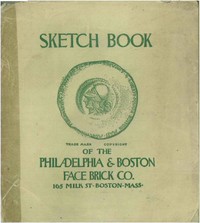
Sketchbook of the Philadelphia & Boston Face Brick Co. — Edition Insights
(0 User reviews)
360
Project Gutenberg
2022
Not confirmed
Fireplaces; Architecture, Domestic; Bricks -- Catalogs
Readers of public-domain and historical texts
Project Gutenberg digital edition
en
Edition facts
Words
10,672
Reading time
47 min
Text sections
60
Sketchbook of the Philadelphia & Boston Face Brick Co. — Edition Insights can be approached with a clearer sense of reading commitment from its source measurements: 10,672 words, 47 min estimated reading time, and 60 detected text sections.
The text analysis averages about 11.5 words per sentence, while the detected sections provide another way to judge how the source is divided.
Project Gutenberg metadata also associates the work with “Fireplaces,” connecting these edition facts with the source record’s subject description.
Source:
Project Gutenberg record #69203
A 1904 trade catalog from the Philadelphia & Boston Face Brick Co. presenting ornamental brick mantels with measured drawings, prices, and brick part numbers, revealing the company's marketing rhetoric and design philosophy.
Read the complete public-domain text at its original source.
Read on Project GutenbergThe Philadelphia & Boston Face Brick Co.'s 1904 catalog opens with a curious blend of poetic sentiment and commercial pragmatism. The preface invokes the hearth as 'the sun in the house' and the 'happiest rallying-place of the family,' yet immediately pivots to a sales pitch: glazed tiles are dismissed as 'cold, hard, and glassy,' relegated to bathrooms, while the company's unglazed brick is presented as the superior alternative. This rhetorical strategy—elevating the fireplace to an emotional center while denigrating competitors—frames the entire sketchbook.
The Rhetoric of the Hearth
The preface employs a deliberate archaism—'From time immemorial the domestic hearth has been the theme of optimists and poets'—to establish a timeless, almost sacred quality for the fireplace. This elevated language contrasts sharply with the catalog's later pages, which are dominated by terse specifications: 'Width of breast 5 feet. Width of opening 2 feet 4 inches.' The company positions its brick mantels as both artistically refined and practically superior. It claims that wooden mantels are 'a sort of makeshift' and that glazed tiles have been 'relegated to bathrooms, elevator shafts, sanitary uses.' The brick, by contrast, is said to have 'the stamp of character' and a 'modest elegance' that 'the eye never tires of.' This dichotomy—poetic ideal versus hard sell—reveals the catalog's dual purpose: to inspire desire for the hearth while providing concrete purchase information.
Measured Drawings and Pricing Logic
Each sketch follows a rigid template: a title (e.g., 'SKETCH No. 37'), dimensions for breast, opening, and mantel height, then a price list. For example, Sketch No. 37 offers a 'low mantel in a corner of a room' at $33 for red brick, or $49.50 for a combination of warm gray and cream bricks. The prices vary by color and complexity: Sketch No. 39, with a mosaic face, costs $70 in red brick and $105 in cream or gray. Notably, the wood shelf is always excluded—'Price of wood shelf not included'—a detail that underscores the catalog's focus on brickwork alone. Each design includes a list of numbered bricks (e.g., 'No. 4 Stretcher,' 'No. 117 Stretcher'), suggesting a modular system where customers could order specific shapes. The repetition of these part numbers across sketches implies a standardized inventory, making the catalog both a design portfolio and a price list.
The Architect's Hand and European Influence
The preface credits 'a well-known Boston architect whose extended European travel rendered him peculiarly fitted for the work' with preparing the designs. This appeal to authority—and to European taste—is a key marketing tactic. The bricks are described as 'patterned after the most artistic Greek and Renaissance designs,' and the catalog claims the resulting mantels have 'the appearance of carved work.' Yet the sketches themselves are purely functional line drawings, not artistic renderings. The text emphasizes that the joints between brick courses 'serve to break up any tendency to a heavy or monumental effect,' aiming for a 'soft, rich, and harmonious' appearance. This balance of classical inspiration and practical construction is the catalog's central aesthetic argument.
Innovations: Mosaic Faces and Portable Fireplaces
Two sketches stand out for their novelty. Sketch No. 39 introduces a 'mosaic face made of the same clay as the brick,' available 'in four shades, from a buff to a red' or 'from a cream to the darkest gray.' This technique allowed for decorative patterns without glazed tiles, aligning with the company's anti-tile rhetoric. Sketch No. 41 depicts a 'portable fireplace' made of iron, lined with fire-brick, and 'copper plated' on the front. It is designed to be 'taken out and moved away in one piece,' with two dampers and a dumping grate. This item represents a departure from the built-in masonry mantels that dominate the catalog, suggesting the company catered to both permanent and flexible installations. The inclusion of such a device hints at a broader market for adaptable heating solutions.
Readers approaching this catalog should attend to the interplay between its lyrical preface and its prosaic specifications. The company's rhetorical choices—dismissing tiles, invoking classical design, and emphasizing the hearth's emotional pull—are as instructive as the dimensions and prices. The numbered brick system and modular designs reveal a sophisticated sales strategy, while the occasional oddity like the portable fireplace reminds us that this was a living commercial document, not a static architectural treatise.
In that 1904 sketchbook, the brick mantels stand sturdy, their prices and part numbers humbling their ornament—yet I always sensed a secret longing for older walls. So it feels right that my shelf holds Old English Mansions — Story, Setting & Ideas, where those same hearths might have dreamed of timber and plaster, a quiet meeting across seventy years.
There are no reviews for this eBook.
There are no comments for this eBook.
Reader reflection
Record your reading impressions
A brief reflection can help important ideas stay with you longer.
Your progress
0
/
10
2
Was reading this book enjoyable?
3
Would you pass this book on to a friend?
4
How easy was the book to follow?
5
Would a second reading be valuable?
6
Did you relate to its people, ideas, or situations?
7
Could you apply anything you learned?
8
How original did the book feel?
9
What is the main idea you are taking away?
10