1

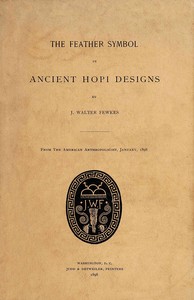
The feather symbol in ancient Hopi designs — Themes and Context
(0 User reviews)
544
Project Gutenberg
2023
Not confirmed
Hopi Indians -- Antiquities; Hopi Indians -- Religion; Hopi Indians -- Rites and ceremonies; Hopi art; Feathers in art
Readers of public-domain and historical texts
Project Gutenberg digital edition
en
Edition facts
Words
8,071
Reading time
36 min
Text sections
2
The source record for The feather symbol in ancient Hopi designs — Themes and Context measures this digital text at 8,071 words, 36 min estimated reading time, and 2 detected text sections.
The text analysis averages about 26.5 words per sentence, while the detected sections provide another way to judge how the source is divided.
Project Gutenberg metadata also associates the work with “Hopi Indians -- Antiquities,” connecting these edition facts with the source record’s subject description.
Source:
Project Gutenberg record #70555
J. Walter Fewkes examines the feather as a recurring decorative and religious symbol on ancient Hopi pottery from Tusayan, tracing its conventionalized forms and arguing that ceramic ornamentation was inseparable from spiritual expression.
Read the complete public-domain text at its original source.
Read on Project GutenbergJ. Walter Fewkes opens this 1898 article by asserting that prehistoric Hopi (Tusayan) pottery bears a 'most elaborate paleography'—a picture writing preserved in Arizona's dry soil. He focuses on one symbol, the feather, which he calls 'one of the more difficult to recognize' due to its metamorphosis in form. The study is explicitly limited to ruins 'purely Hopi in origin,' and Fewkes acknowledges that interpretation of Pueblo ceramic designs is 'as yet in its infancy.'
A Symbolic Alphabet on Ancient Pots
Fewkes treats the feather as a 'letter' in an alphabet of design, claiming that feather symbols or simple modifications appear on 'almost three-fourths of all the decorated ancient vessels of Tusayan.' He illustrates several variants—for instance, a feather with markings shown in figure 10, which hangs from a zone around a vase and is compared to feathers tied about modern ceremonial vessels. The article reproduces specific examples from sites like Sikyatki, including a ladle and vases where the feather appears near the orifice. Fewkes does not claim to interpret every instance; he explicitly excludes doubtful cases where a figure 'was probably intended for a feather symbol' but cannot be proven.
Religious Motive Over Aesthetic
Fewkes argues that the ruling motive in decorating ancient Hopi vessels was religious, not simply beautification. He writes that 'esthetic and religious feelings were not differentiated' and that to decorate a vessel without a religious symbol was 'an impossibility.' This claim is supported by the feather's prominence in modern Hopi ritual paraphernalia, which Fewkes had documented in earlier publications. He contrasts this with contemporary Hopi pottery, which he sees as deteriorating because 'the new conception of beauty has crowded out the religious element.' Patterns are now 'mechanically followed, through conservatism,' and Fewkes predicts that trade with whites will lead to further degeneracy, with pottery becoming a commercial product rather than a medium of religious expression.
Evidence from the Excerpts: What the Text Actually Shows
The excerpts confirm that Fewkes's argument rests on a limited set of illustrated vessels from specific ruins, not a comprehensive survey. He identifies feather symbols by their position and markings, but the reader never sees the figures themselves—only descriptions like 'a section of a small, beautiful vase, with the decoration confined to the equatorial region.' The catalog subjects list 'Hopi Indians — Religion' and 'Feathers in art,' but the text does not describe ceremonies or myths in detail; it infers religious intent from the symbol's recurrence. Fewkes also notes that 'two or three other letters' in the alphabet exist but are omitted due to space, leaving the feather as the sole focus. The excerpts thus support a narrow, evidence-based claim about one decorative element, not a full account of Hopi symbolism.
Fewkes's article is best read as a focused archaeological note rather than a general ethnography. Readers interested in Hopi religion or art history should note that the evidence is entirely ceramic and limited to a few sites. The author's predictions about cultural decline reflect late-nineteenth-century assumptions; the value of the piece lies in its detailed attention to a single motif and its attempt to decode meaning from form.
I’ve often thought the feather on old Hopi pots was a prayer made visible, just as William’s quill turned ink into prophecy. Each maker trusted the same quiet belief—that ornament and verse could carry spirit beyond the hand that shaped it. Looking at William Blake, Painter and Poet — Context and Discussion, I recall that same reverence, that same patient line.
There are no reviews for this eBook.
There are no comments for this eBook.
Reader reflection
Take a moment to reflect on this book
Create a short personal record of your experience with this book.
Your progress
0
/
10
2
How much did you enjoy the reading experience?
3
Would you pass this book on to a friend?
4
How much effort did this book require?
5
What did you appreciate most?
6
How strong was your personal connection to the text?
7
Was the book easy to understand?
8
Could you apply anything you learned?
9
Which lesson or insight stayed with you?
10