1

A Treatise on Painting — A Closer Reading
(0 User reviews)
147
Project Gutenberg
2014
Not confirmed
Leonardo, da Vinci, 1452-1519; Painting -- Technique -- Early works to 1800; Drawing -- Technique -- Early works to 1800
Readers of public-domain and historical texts
Project Gutenberg digital edition
en
Edition facts
Words
74,696
Reading time
325 min
Text sections
12
The source record for A Treatise on Painting — A Closer Reading measures this digital text at 74,696 words, 5 hr 25 min estimated reading time, and 12 detected text sections.
The text analysis averages about 23.8 words per sentence, while the detected sections provide another way to judge how the source is divided.
Project Gutenberg metadata also associates the work with “Leonardo, da Vinci, 1452-1519,” connecting these edition facts with the source record’s subject description.
Source:
Project Gutenberg record #46915
Leonardo da Vinci's practical instructions on painting, drawing, proportion, anatomy, and motion, translated by J.F. Rigaud with a new biography by John Sidney Hawkins. The work emphasizes observation of nature, dynamic composition, and the painter's need to capture sudden actions and complex attitudes.
Read the complete public-domain text at its original source.
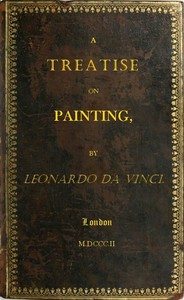
Read on Project GutenbergLeonardo da Vinci's A Treatise on Painting, as presented in this 1802 edition, is less a unified book than a collection of practical precepts organized under headings such as Drawing, Proportion, Anatomy, and Motion. The translator J.F. Rigaud and commentator John Sidney Hawkins have shaped the material into a digestible form, adding a new biography of Leonardo drawn from sources previously inaccessible. The excerpts reveal a text preoccupied with the mechanics of the human body in action—how limbs bend, how weight shifts, how a figure running must throw one arm forward and the other back. This is not abstract theory but workshop knowledge, grounded in the conviction that painting must be learned through disciplined observation of nature.
The Body in Motion: Contrast and Counterpoise
Leonardo insists that a single figure should not repeat the same motion in its members. A running figure, he writes, must not throw both hands forward; instead, one arm goes forward and the other backward, because without such contraste of parts it is impossible to run well. This principle extends to groups: in a battle scene, where there are only three ways of striking—thrusting, cutting, or back-handed—the painter must vary the views so that some figures turn their backs, others their sides, and others face the front. The goal is to avoid monotony and to generate what Leonardo calls “complex motion,” such as a figure showing the front of the legs while simultaneously presenting the profile of the shoulder. Such complexity, he argues, displays great art and gives spirit and animation to the whole.
Learning from Nature, Not from Memory Alone
Leonardo advises the painter to observe men’s motions and actions as they occur during sudden accidents, sketching on the spot rather than later asking a model to counterfeit an emotion without cause. An expression of weeping produced artificially, he warns, will be “neither quick nor natural.” The proper method is to watch real events, then use a model in the same attitude to help the recollection. This emphasis on direct observation recurs throughout the excerpts: the student is told to draw from casts or nature, to study in the dark on first waking, and to remember a face after seeing it only once. The painter’s memory is a tool, but it must be fed by constant, attentive looking at the world.
The Storm as a Test of Compositional Skill
Leonardo’s instructions for representing a storm reveal how he translates natural phenomena into pictorial terms. The painter must consider the wind’s effects: clouds straggling and broken, dust raised from sandy shores, branches and leaves carried along by the violence. The storm is not merely a backdrop but a dynamic force that rearranges the entire scene. Leonardo’s method is analytical—he breaks the storm into its visible components (clouds, dust, vegetation) and prescribes how each should be depicted to convey the wind’s direction and force. This approach mirrors his broader teaching: every element in a picture must serve the overall motion and narrative, whether it is a human figure in combat or a tree bending in a gale.
Readers approaching this treatise should expect a fragmented but richly detailed manual, one that rewards slow reading and cross-reference between chapters. Leonardo’s advice is often concrete—how to proportion a child versus an adult, how to draw from reliefs—but it is underpinned by a consistent philosophy: painting is a science of observation and motion. The 1802 edition’s apparatus, including Hawkins’s biography and Rigaud’s translation, frames Leonardo as both artist and natural philosopher. For those interested in the practical craft of Renaissance painting, this text offers direct insight into the working methods of one of its greatest practitioners.
I kept thinking about how Leonardo wanted painters to catch the body mid-motion, that fleeting tension. It reminded me of the quiet way stonework holds centuries of hands and intentions, a different kind of pause. There’s a gentleness in that persistence, like reading Lectures on the rise and development of medieval architecture; vol. 2 — Text and Context, where buildings seem to breathe slowly, asking only for your patience.
There are no reviews for this eBook.
There are no comments for this eBook.
Reader reflection
Your personal reading reflection
Build a private reading journal entry for this title.
Your progress
0
/
10
2
What was your overall reaction to the book?
3
Would you encourage someone else to read it?
4
What was the reading difficulty like?
5
How did the pace of the book feel?
6
How well did it match your expectations?
7
Would you like to discuss this book with someone?
8
Which element worked best for you?
9
What changed or sharpened your thinking?
10