1

Architecture — A Reader’s Guide
(0 User reviews)
1388
Project Gutenberg
2023
Not confirmed
Architecture, Modern -- 19th century; Architecture, Modern -- 20th century
Readers of public-domain and historical texts
Project Gutenberg digital edition
en
Edition facts
Words
279,773
Reading time
1217 min
Text sections
58
The catalog record for Architecture — A Reader’s Guide provides practical reading context through 279,773 words, 20 hr 17 min estimated reading time, and 58 detected text sections.
The text analysis averages about 23.7 words per sentence, while the detected sections provide another way to judge how the source is divided.
Project Gutenberg metadata also associates the work with “Architecture, Modern -- 19th century,” connecting these edition facts with the source record’s subject description.
Source:
Project Gutenberg record #70079
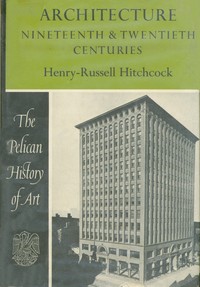
Henry-Russell Hitchcock's survey traces architecture from 1800 to mid-century, emphasizing commercial buildings as key innovations. The text contrasts masonry-sheathed skyscrapers with exposed metal-and-glass structures, and highlights reinforced concrete's rise. Hitchcock argues that enlightened commercial patrons often received the best architecture of their day.
Read the complete public-domain text at its original source.
Read on Project GutenbergHitchcock opens his survey by positioning commercial architecture as the nineteenth century's greatest single innovation, arguing that office buildings achieved a prestige comparable to churches and palaces in earlier periods. He contrasts the masonry-sheathed 'skyscraper construction' of Chicago with the exposed metal-and-glass department stores of Continental Europe, noting that the latter are closer in character to cast-iron commercial buildings of the mid-century than to tall steel-framed structures. The text also tracks the gradual spread of steel construction and the rise of reinforced concrete as a rival material.
Commercial Architecture as Creative Catalyst
Hitchcock asserts that the functional and technical challenges of commercial building consistently brought out the creative capacities of architects more than other commissions. He cites specific comparisons: Parris's granite 'skeleton' fronts beside the Quincy Market versus his Grecian temple church; Godwin's Stokes Croft Warehouse against his town halls; and Richardson's Field store measured against his Pittsburgh Jail. These juxtapositions are meant to demonstrate the strictly architectural significance of commercial monuments, not merely their technical or social importance. The chapter summarizes what Hitchcock calls 'the rise of a new type of building to a position of prestige and of achievement.'
Materials and Structural Systems in Tension
The text repeatedly contrasts two structural approaches: the American type of steel skeleton with protective masonry cladding, and the European tradition of exposed metal-and-glass construction. Hitchcock notes that the latter climaxed around 1900 in association with Art Nouveau, while steel construction gradually spread worldwide but remained 'typically American.' Reinforced concrete, with technical beginnings in the mid-nineteenth century, was not exploited on a large scale until the 1890s. Hitchcock points out that in most countries outside America, reinforced concrete rivals or replaces steel as the characteristic material for large structures.
Domestic Architecture as a Counterpoint
Hitchcock explicitly states that the house was 'hardly a nineteenth-century invention like the office building,' yet it was modified almost beyond recognition over the century. Around 1900, he observes, there were few churches to rival Sullivan's skyscrapers in quality, but there were notable houses—especially those by Sullivan's disciple Wright and by English contemporaries. This framing sets up a tension between the innovative commercial typology and the evolving but less radically new domestic tradition. The text implies that the house, while not a new type, became a site for architectural experimentation that paralleled but did not surpass the achievements of commercial building.
Hitchcock's narrative is built on contrasts—between materials, structural systems, building types, and national traditions. Readers will find that his comparative method, often pairing specific buildings by the same architect, rewards close attention. The text assumes familiarity with architectural terminology and a broad historical framework, but its core argument about the primacy of commercial architecture offers a clear lens through which to assess the examples and plates.
I have shelved Hitchcock’s survey for decades, watching him champion the modest commercial block beside the grand cathedral of glass. It always reminded me of another volume’s quiet delight in the camera’s small tricks—light bent through a lens, a portrait that fools the eye. Perhaps all craft is honest play. That old book, Photographic Amusements, Ninth Edition Including A Description of a Number of Novel Effects Obtainable with the Camera — A Reader’s Guide, practices its own gentle architecture of patience and surprise.
There are no reviews for this eBook.
There are no comments for this eBook.
Reader reflection
What was your reading experience?
Capture what you thought, learned, and would like to remember.
Your progress
0
/
10
2
What was your overall reaction to the book?
3
Would you encourage someone else to read it?
4
How demanding did the text feel?
5
Did you gain anything practical from the text?
6
How did the reading compare with what you expected?
7
Was the book easy to understand?
8
What did you appreciate most?
9
What did this book teach you most?
10