1

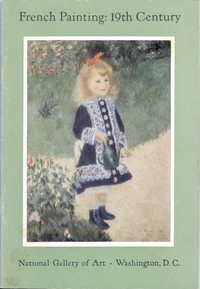
French Painting of the 19th Century in the National Gallery of Art — Context and Discussion
(0 User reviews)
1565
Project Gutenberg
2019
Not confirmed
Painting, French
Readers of public-domain and historical texts
Project Gutenberg digital edition
en
Edition facts
Words
9,401
Reading time
41 min
Text sections
2
The source record for French Painting of the 19th Century in the National Gallery of Art — Context and Discussion measures this digital text at 9,401 words, 41 min estimated reading time, and 2 detected text sections.
The text analysis averages about 22.1 words per sentence, while the detected sections provide another way to judge how the source is divided.
Project Gutenberg metadata also associates the work with “Painting, French,” connecting these edition facts with the source record’s subject description.
Source:
Project Gutenberg record #59288
This editorial note examines Grose Evans's authorial choices in diction, dialogue, and description within his 1967 guide to 19th-century French paintings at the National Gallery of Art, focusing on how he characterizes artists, movements, and individual works through precise language and structural decisions.
Read the complete public-domain text at its original source.
Read on Project GutenbergGrose Evans opens his guide with a declarative sentence that frames the entire narrative: “The story of French painters during the nineteenth century is an exciting one, colored by personal rivalries and revolutions in taste.” This choice of “story” rather than “history” signals a deliberate narrative approach, while “colored” subtly introduces the visual theme. Throughout the text, Evans employs a consistent pattern of pairing biographical anecdote with technical analysis, as seen in his account of David’s four Prix de Rome failures and attempted suicide before success—a detail that humanizes the artist without romanticizing. The author’s diction often carries evaluative weight: Ingres paints with “precise, sculpturesque draftsmanship and coldly calculated color,” where “coldly” implies a critical stance. Such phrasing reveals Evans’s own taste while maintaining an authoritative tone.
Narrative Framing and Artist Portraits
Evans structures each artist entry as a mini-biography followed by a description of one or two representative works. The biographies are compressed but vivid: David is introduced as “son of a Paris tradesman” who “reacted violently against the gay, trivial style” of aristocratic painting. The word “violently” is striking—it suggests emotional intensity rather than mere aesthetic disagreement. For Ingres, Evans notes his “apprenticeship with David and eighteen years spent in Italy” as formative, then immediately links this to his style: “paint with precise, sculpturesque draftsmanship and coldly calculated color.” The cause-and-effect structure implies that Ingres’s training directly produced his manner. Evans also uses contrast to define artists: David’s “sober and ‘elevating’ imitation of classical art” is set against the “gay, trivial style” he rejected. These oppositions create a clear moral and aesthetic hierarchy.
Descriptive Precision in Painting Analysis
When describing individual paintings, Evans shifts to a more technical register. For Monet’s Rouen Cathedral, West Façade, Sunlight, he writes: “The hot sun of early afternoon blazes down upon the lacy stone façade… The myriad glowing spots of color almost dissolve the cathedral’s form.” The verb “blazes” and the adjective “lacy” are sensory and specific. Evans then explains Monet’s method: “Small, separate touches of paint, prismatic in their brilliance, complement each other to dazzle the eye and suggest the shimmer of actual light.” This is not mere description but an explanation of technique. He quotes Cézanne’s remark—“Monet was only an eye, but what an eye!”—as a capsule judgment. For Manet’s The Railroad, Evans notes that “broad silhouettes of contrasting colors lend the picture its sparkle, while graceful curving contours… form a pleasing design.” The word “pleasing” is understated, avoiding hyperbole.
Comparative Language and Artistic Lineages
Evans frequently places artists in relation to one another, creating a web of influence and divergence. He writes that Berthe Morisot “was strongly influenced by Impressionism” but that her colors “have not the daring brilliance of the spectrum hues Monet used.” Instead, she “sustained a refined color harmony of delicate warm and cool hues.” The word “refined” suggests a qualitative judgment—Morisot’s work is more restrained, perhaps more tasteful. Evans also notes that her composition “shows her allegiance to Manet rather than to Monet; the forms are broadly seen in silhouette.” This comparative approach extends to the Academy: “Behind it the Academy had the weight of traditionally accepted theory and the splendid accomplishments of the Old Masters.” The phrase “splendid accomplishments” is notably positive, yet the Academy is portrayed as an obstacle to innovation. Evans’s language thus subtly champions the avant-garde while acknowledging the establishment’s merits.
Recurring Motifs and Structural Choices
Several motifs recur across the excerpts. One is the idea of risk: artists “could only be original at their own peril,” and David’s early failures are emphasized. Another is the importance of light: Monet’s “ultimate achievement in capturing sunlight,” Morisot’s interest in how objects “reflected light in different ways,” and Degas’s use of “the artificial richness of stage lighting.” Evans also consistently notes the medium and dimensions of each painting, as in “Canvas. 39½ × 28¾ inches. Dated 1876.” This catalog-like precision grounds the descriptions in material fact. Structurally, Evans moves chronologically from David through Ingres to the Impressionists, but within that framework he groups artists by style or theme. The text is divided into sections with bold headings for each artist, making it easy to navigate. The author’s voice remains consistently authoritative, using declarative sentences and avoiding hedging language.
Evans’s guide rewards careful attention to his word choices: a single adjective like “coldly” or “refined” can encapsulate his critical perspective. Readers may find it useful to compare his descriptions of similar subjects—for instance, how he treats light in Monet versus Morisot—to see how he differentiates artistic approaches. The book’s brevity (9,401 words) means every sentence carries weight; no passage is filler. Approaching the text as a crafted argument about artistic value, rather than a neutral reference, will yield the richest understanding of Evans’s perspective on 19th-century French painting.
There’s something about the way Evans lingers on a single brushstroke in that old National Gallery guide—not explaining, just letting the quiet speak. It reminded me of another voice, patient and unhurried, that does the same for Renaissance craft. I found myself holding my breath at the margins, the way one does with A Treatise on Painting — A Closer Reading. That book stayed with me like a half-remembered light.
There are no reviews for this eBook.
There are no comments for this eBook.
Reader reflection
Before you leave, reflect on the book
Use these questions to collect your thoughts before moving on.
Your progress
0
/
10
2
What was your overall reaction to the book?
3
Is this a title you would suggest to others?
4
How much effort did this book require?
5
What did you think about the pace?
6
Could you follow the author’s main argument?
7
Would a second reading be valuable?
8
What did you appreciate most?
9
What is the main idea you are taking away?
10