1

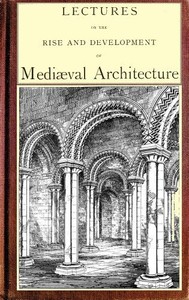
Lectures on the rise and development of medieval architecture; vol. 2 — Text and Context
(0 User reviews)
239
Project Gutenberg
2020
Not confirmed
Architecture, Gothic; Architecture, Medieval
Readers of public-domain and historical texts
Project Gutenberg digital edition
en
Edition facts
Words
90,881
Reading time
396 min
Text sections
17
Lectures on the rise and development of medieval architecture; vol. 2 — Text and Context can be approached with a clearer sense of reading commitment from its source measurements: 90,881 words, 6 hr 36 min estimated reading time, and 17 detected text sections.
The text analysis averages about 19.7 words per sentence, while the detected sections provide another way to judge how the source is divided.
Project Gutenberg metadata also associates the work with “Architecture, Gothic,” connecting these edition facts with the source record’s subject description.
Source:
Project Gutenberg record #61646
Sir George Gilbert Scott's second volume of lectures examines the technical and artistic evolution of medieval architecture in Great Britain, focusing on Anglo-Saxon and Norman construction methods, rib vaulting geometry, and the transition from Romanesque to Gothic forms through precise analysis of structural details.
Read the complete public-domain text at its original source.
Read on Project GutenbergScott opens this volume by situating British medieval architecture within a broader European context, tracing early developments in Scotland, Ireland, and Anglo-Saxon England. He draws on recent research in Central Syria to illuminate parallels, but his focus quickly narrows to the material evidence of churches such as Brixworth, Worth, and Bradford. The lectures are not mere descriptions; Scott dissects the mechanical logic behind Norman vaulting, showing how builders resolved the intersection of transverse, diagonal, and wall ribs. His language is precise, often technical, as when he explains how rib sections must be set back or forward on the springing line to achieve a level ridge. This is a practitioner’s history, written by an architect who designed the New Law Courts and restored countless medieval buildings.
Anglo-Saxon Foundations and Their Characteristics
Scott devotes considerable attention to pre-Conquest architecture, cataloguing surviving examples and attempting to classify them into periods. He notes that churches founded by St. Augustine at Canterbury and York, along with later structures at Hexham, Ripon, and Ramsey, provide a fragmented record. The destruction wrought by Sweyn and the subsequent rebuilding under Canute, Scott argues, introduced Roman models that reshaped English building traditions. He identifies characteristic Anglo-Saxon features: narrow, tall proportions; rough stonework; and the use of long-and-short work in quoins. At Brixworth, he observes a basilican plan with an apsidal east end, while at Jarrow-on-Tyne the chancel retains what he calls a “Saxon” character in its simple, massive masonry. Scott is careful to distinguish these from Norman work, though he admits that dating is often uncertain without excavation or documentary evidence.
Norman Ambition and Structural Logic
The Norman period, Scott contends, brought a “vast scale and number of works” that transformed English architecture. He traces the influence of St. Stephen’s at Caen on Canterbury Cathedral, and describes the Confessor’s Westminster Abbey as a transitional building. The lectures then move through a litany of major Norman churches: St. Alban’s, Winchester, Ely, Durham, and others. Scott’s interest lies in the mechanical ideal of a great Norman church—its massive walls, round arches, and groin vaults. He explains how the “new manner of building” at the close of the eleventh century required careful coordination of ribs and centering. The vaulting sections are the most detailed in the volume, with Scott using diagrams to show how transverse and diagonal ribs intersect at the springing, and how the curvature of courses allowed masons to dispense with continuous timber centering. This is not mere description; it is a reconstruction of the builder’s reasoning.
The Geometry of Rib Vaulting
Scott’s analysis of rib vaulting is the technical heart of the volume. He explains that in early vaults, ribs are “square and flat at the back,” with the vaulting mass resting on their backs. Later ribs became deeper and were “rebated” to receive the vaulting surface. The key challenge, Scott writes, is setting out the ribs on the springing line so that they “clear themselves one of another” at the same height. He provides a geometric method: draw the curve of one rib, then the vertical line of its intersection with the next, and from the apex of the adjoining rib draw its curve through that intersection to find the correct setback. This procedure, he notes, is especially tricky in oblong vaults where the wall rib travels a shorter distance to reach a given height. Scott’s language is that of a teacher: he uses figures 358–362 to illustrate how the group of ribs is built in horizontal courses until they separate, and how the filling-in of the vaulting surface must be carefully planned to avoid “needless twisting.”
From Romanesque to Gothic: The Evidence of Details
Throughout the lectures, Scott uses minor details—doorways, windows, arcades, and mouldings—to trace stylistic evolution. He notes that Norman work often combines elements in varied ways, and that the transition to Gothic is visible in the increasing slenderness of shafts and the use of pointed arches. The vaulting ribs, he observes, became “beautifully moulded, and sometimes decorated” in later periods, while the outer thickness of the vault was eventually dispensed with as “a superfluous load.” Scott also discusses the crypts at Wing, Repton, and Lastingham, and the distinctive towers at Earls Barton, Sompting, and Clapham. His method is cumulative: each example adds a piece to the puzzle of how medieval builders solved structural problems while achieving aesthetic effects. The lectures do not offer a grand theory; they present a working architect’s careful observations, grounded in the physical remains he knew firsthand.
Scott’s lectures reward readers who attend to the technical passages, where the author’s own experience as a Gothic Revival architect informs his reading of medieval methods. The diagrams and descriptions of rib vaulting are best studied with patience; they reveal how much of medieval building was a matter of practical geometry. For those interested in the transition from Romanesque to Gothic, or in the history of architectural restoration, this volume offers a contemporary voice—one that shaped the Victorian understanding of the Middle Ages.
I remember standing in a cold Norfolk church, tracing the rough Norman arches with my eyes—how their weight felt like a held breath. This book’s slow, careful dissection of that heavy stonework brought it back. Years earlier, Rural architecture — A Reader’s Guide gave me the same quiet thrill: a simple shed, suddenly ancient and articulate. Both make me feel small, and oddly comforted.
There are no reviews for this eBook.
There are no comments for this eBook.
Reader reflection
What was your reading experience?
Capture what you thought, learned, and would like to remember.
Your progress
0
/
10
2
What was your overall reaction to the book?
3
Would you pass this book on to a friend?
4
Did the language feel accessible?
5
Could you see yourself revisiting this book?
6
How clear did the writing feel?
7
Did it raise ideas you would like to talk about?
8
Was the book what you thought it would be?
9
Which lesson or insight stayed with you?
10